Cause all that matters here is passing exam with AZ-100 Free Practice Questions. Cause all that you need is a high score of AZ-100 Study Guides. The only one thing you need to do is downloading AZ-100 Exam Questions free now. We will not let you down with our money-back guarantee.
Also have AZ-100 free dumps questions for you:
NEW QUESTION 1
You configure Azure AD Connect for Azure Active Directory Seamless Single Sign-On (Azure AD Seamless SSO) for an on-premises network. Users report that when they attempt to access myapps.microsoft.com, they are prompted multiple times to sign in and are forced to use an account name that ends with onmicrosoft.com.
You discover that there is a UPN mismatch between Azure AD and the on-premises Active Directory. You need to ensure that the users can use single-sign on (SSO) to access Azure resources.
What should you do first?
- A. From the on-premises network, deploy Active Directory Federation Services (AD FS).
- B. From Azure AD, add and verify a custom domain name.
- C. From the on-premises network, request a new certificate that contains the Active Directory domain name.
- D. From the server that runs Azure AD Connect, modify the filtering options.
Answer: B
Explanation: Azure AD Connect lists the UPN suffixes that are defined for the domains and tries to match them with a custom domain in Azure AD. Then it helps you with the appropriate action that needs to be taken. The Azure AD sign-in page lists the UPN suffixes that are defined for on-premises Active Directory and displays the corresponding status against each suffix. The status values can be one of the following:
State: Verified
Azure AD Connect found a matching verified domain in Azure AD. All users for this domain can sign in by using their on-premises credentials.
State: Not verified
Azure AD Connect found a matching custom domain in Azure AD, but it isn't verified. The UPN suffix of the users of this domain will be changed to the default .onmicrosoft.com suffix after synchronization if the domain isn't verified.
Action Required: Verify the custom domain in Azure AD.
References: https://docs.microsoft.com/en-us/azure/active-directory/hybrid/plan-connect-user-signin
NEW QUESTION 2
You have an Azure Active Directory (Azure AD) tenant named contosocloud.onmicrosoft.com. Your company has a public DNS zone for contoso.com.
You add contoso.com as a custom domain name to Azure AD. You need to ensure that Azure can verify the domain name. Which type of DNS record should you create?
- A. RRSIG
- B. PTR
- C. DNSKEY
- D. TXT
Answer: D
Explanation: Create the TXT record. App Services uses this record only at configuration time to verify that you own the custom domain. You can delete this TXT record after your custom domain is validated and configured in App Service.
References: https://docs.microsoft.com/en-us/azure/dns/dns-web-sites-custom-domain
NEW QUESTION 3
You have an Azure virtual machine named VM1 that you use for testing. VM1 is protected by Azure Backup. You delete VM1.
You need to remove the backup data stored for VM1. What should you do first?
- A. Modify the backup policy.
- B. Delete the Recovery Services vault.
- C. Stop the backup.
- D. Delete the storage account.
Answer: A
Explanation: Azure Backup provides backup for virtual machines — created through both the classic deployment model and the Azure Resource Manager deployment model — by using custom-defined backup policies in a Recovery Services vault.
With the release of backup policy management, customers can manage backup policies and model them to meet their changing requirements from a single window. Customers can edit a policy, associate more virtual machines to a policy, and delete unnecessary policies to meet their compliance requirements.
NEW QUESTION 4
You have an Azure Storage accounts as shown in the following exhibit.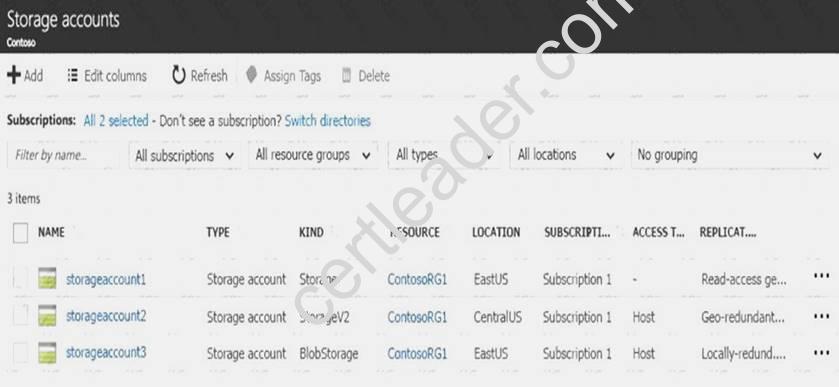
Use the drop-down menus to select the answer choice that completes each statement based on the information presented in the graphic.
NOTE: Each correct selection is worth one point.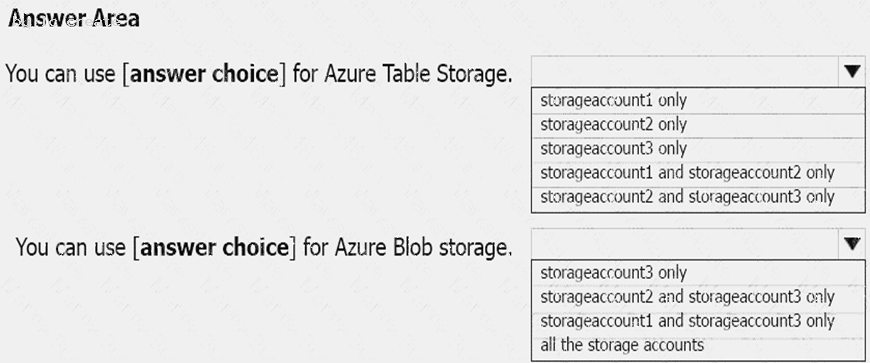
Answer:
Explanation: Box 1: storageaccount1 and storageaccount2 only Box 2: All the storage accounts
Note: The three different storage account options are: General-purpose v2 (GPv2) accounts, General-purpose v1 (GPv1) accounts, and Blob storage accounts. General-purpose v2 (GPv2) accounts are storage accounts that support all of the latest features for blobs, files, queues, and tables. Blob storage accounts support all the same block blob features as GPv2, but are limited to supporting only block blobs. General-purpose v1 (GPv1) accounts provide access to all Azure Storage services, but may not have the latest features or the lowest per gigabyte pricing.
References: https://docs.microsoft.com/en-us/azure/storage/common/storage-account-options
NEW QUESTION 5
Click to expand each objective. To connect to the Azure portal, type https://portal.azure.com in the browser address bar.
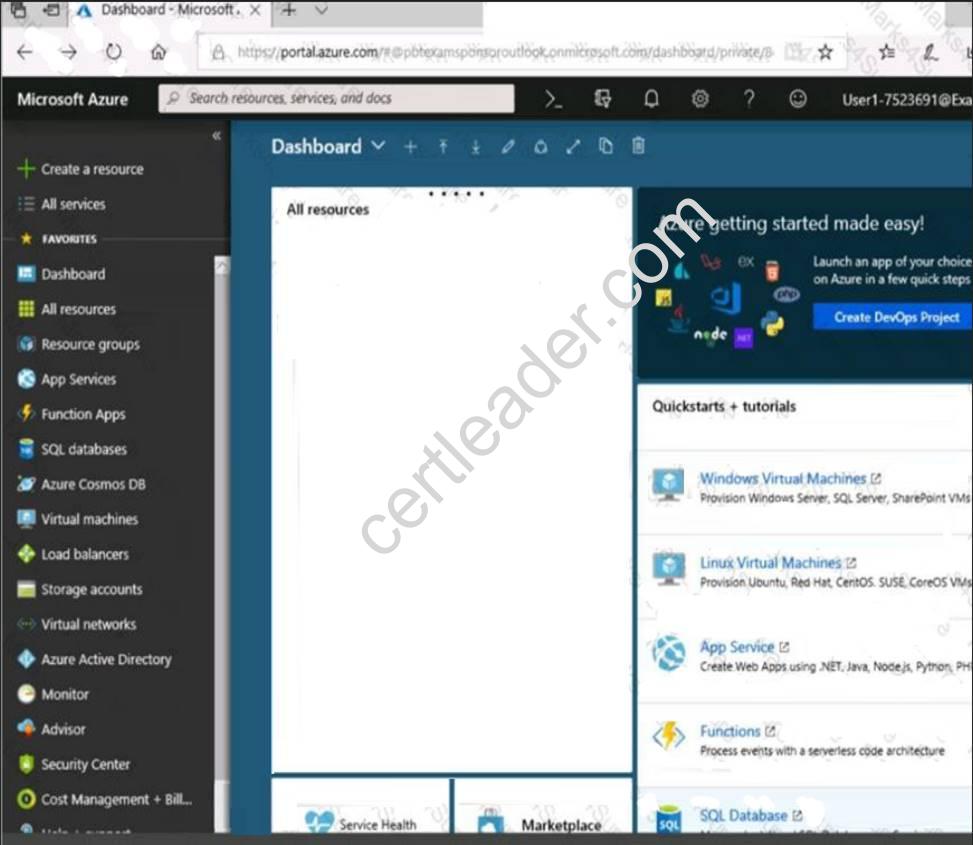
When you are finished performing all the tasks, click the ‘Next’ button.
Note that you cannot return to the lab once you click the ‘Next’ button. Scoring occur in the background while you complete the rest of the exam.
Overview
The following section of the exam is a lab. In this section, you will perform a set of tasks in a live environment. While most functionality will be available to you as it would be in a live environment, some functionality (e.g., copy and paste, ability to navigate to external websites) will not be possible by design. Scoring is based on the outcome of performing the tasks stated in the lab. In other words, it doesn’t matter how you accomplish the task, if you successfully perform it, you will earn credit for that task.
Labs are not timed separately, and this exam may have more than one lab that you must complete. You can use as much time as you would like to complete each lab. But, you should manage your time appropriately to ensure that you are able to complete the lab(s) and all other sections of the exam in the time provided.
Please note that once you submit your work by clicking the Next button within a lab, you will NOT be able to return to the lab.
To start the lab
You may start the lab by clicking the Next button.
Your on-premises network uses an IP address range of 131.107.2.0 to 131.107.2.255.
You need to ensure that only devices from the on-premises network can connect to the rg1lod7523691n1 storage account.
What should you do from the Azure portal?
Answer:
Explanation: Step 1: Navigate to the rg1lod7523691n1 storage account.
Step 2: Click on the settings menu called Firewalls and virtual networks.
Step 3: Ensure that you have elected to allow access from 'Selected networks'.
Step 4: To grant access to an internet IP range, enter the address range of 131.107.2.0 to 131.107.2.255 (in CIDR format) under Firewall, Address Ranges.
References: https://docs.microsoft.com/en-us/azure/storage/common/storage-network-security
NEW QUESTION 6
You sign up for Azure Active Directory (Azure AD) Premium.
You need to add a user named admin1@contoso.com as an administrator on all the computers that will be joined to the Azure AD domain.
What should you configure in Azure AD?
- A. Device settings from the Devices blade.
- B. General settings from the Groups blade.
- C. User settings from the Users blade.
- D. Providers from the MFA Server blade.
Answer: C
Explanation: When you connect a Windows device with Azure AD using an Azure AD join, Azure AD adds the following
security principles to the local administrators group on the device: The Azure AD global administrator role
The Azure AD device administrator role The user performing the Azure AD join
In the Azure portal, you can manage the device administrator role on the Devices page. To open the Devices page:
1. Sign in to your Azure portal as a global administrator or device administrator.
2. On the left navbar, click Azure Active Directory.
3. In the Manage section, click Devices.
4. On the Devices page, click Device settings.
5. To modify the device administrator role, configure Additional local administrators on Azure AD joined devices.
References: https://docs.microsoft.com/en-us/azure/active-directory/devices/assign-local-admin
NEW QUESTION 7
You have an Azure subscription that contains a storage account.
You have an on-premises server named Server1 that runs Window Server 2021. Server1 has 2 TB of data. You need to transfer the data to the storage account by using the Azure Import/Export service.
In which order should you perform the actions? To answer, move all actions from the list of actions to the answer area and arrange them in the correct order.
NOTE: More than one order of answer choices is correct. You will receive credit for any of the correct orders you select.
Answer:
Explanation: 
NEW QUESTION 8
You have peering configured as shown in the following exhibit.
Use the drop-down menus to select the answer choice that completes each statement based on the information presented in the graphic.
NOTE: Each correct selection is worth one point.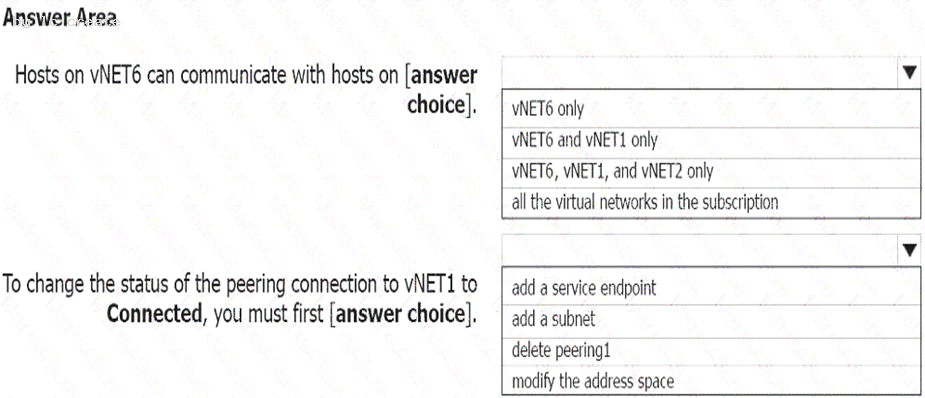
Answer:
Explanation: Box 1: vNET6 only
Box 2: Modify the address space
The virtual networks you peer must have non-overlapping IP address spaces. References:
https://docs.microsoft.com/en-us/azure/virtual-network/virtual-network-manage-peering#requirements-and-cons
NEW QUESTION 9
You need to implement a backup solution for App1 after the application is moved. What should you create first?
- A. a recovery plan
- B. an Azure Backup Server
- C. a backup policy
- D. a Recovery Services vault
Answer: D
Explanation: A Recovery Services vault is a logical container that stores the backup data for each protected resource, such as Azure VMs. When the backup job for a protected resource runs, it creates a recovery point inside the Recovery Services vault.
Scenario:
There are three application tiers, each with five virtual machines. Move all the virtual machines for App1 to Azure.
Ensure that all the virtual machines for App1 are protected by backups.
References: https://docs.microsoft.com/en-us/azure/backup/quick-backup-vm-portal
NEW QUESTION 10
You have an Azure tenant that contains two subscriptions named Subscription1 and Subscription2.
In Subscription1, you deploy a virtual machine named Server1 that runs Windows Server 2021. Server1 uses managed disks.
You need to move Server1 to Subscription2. The solution must minimize administration effort. What should you do first?
- A. In Subscription2, create a copy of the virtual disk.
- B. From Azure PowerShell, run the Move-AzureRmResource cmdlet.
- C. Create a snapshot of the virtual disk.
- D. Create a new virtual machine in Subscription2.
Answer: B
Explanation: To move existing resources to another resource group or subscription, use the Move-AzureRmResource cmdlet.
References:
https://docs.microsoft.com/en-in/azure/azure-resource-manager/resource-group-move-resources#moveresources
NEW QUESTION 11
You have an Azure subscription named Subscription1. Subscription1 contains the resources in the following table.
In Azure, you create a private DNS zone named adatum.com. You set the registration virtual network to VNet2. The adatum.com zone is configured as shown in the following exhibit.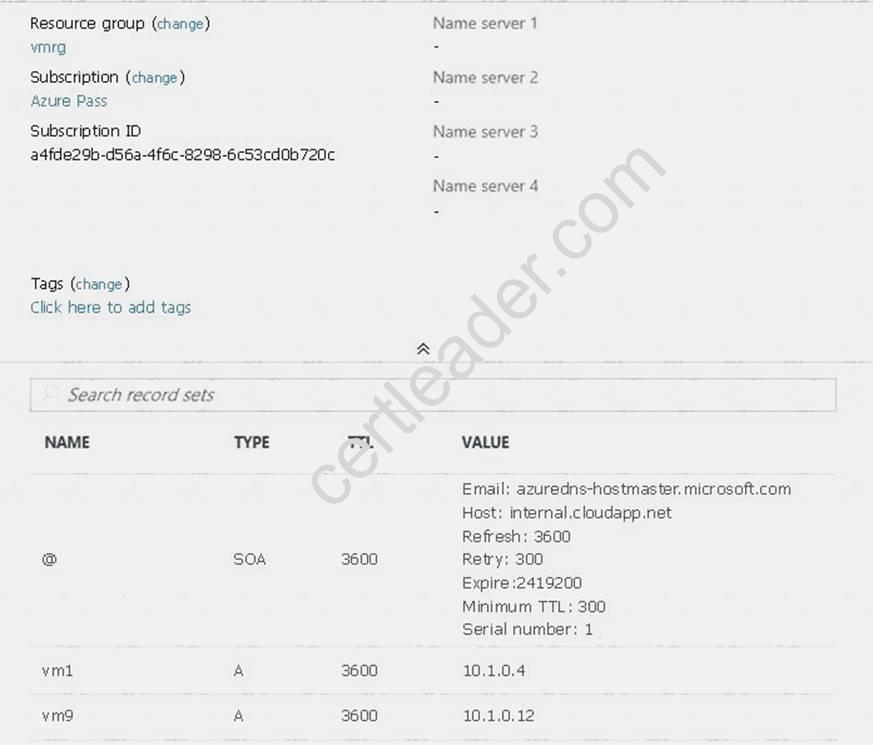
For each of the following statements, select Yes if the statement is true. Otherwise, select No. NOTE: Each correct selection is worth one point.
Answer:
Explanation: Box 1: No
Azure DNS provides automatic registration of virtual machines from a single virtual network that's linked to a private zone as a registration virtual network. VM5 does not belong to the registration virtual network though.
Box 2: No
Forward DNS resolution is supported across virtual networks that are linked to the private zone as resolution virtual networks. VM5 does belong to a resolution virtual network.
Box 3: Yes
VM6 belongs to registration virtual network, and an A (Host) record exists for VM9 in the DNS zone.
By default, registration virtual networks also act as resolution virtual networks, in the sense that DNS resolution against the zone works from any of the virtual machines within the registration virtual network.
References: https://docs.microsoft.com/en-us/azure/dns/private-dns-overview
NEW QUESTION 12
You have an Azure policy as shown in the following exhibit.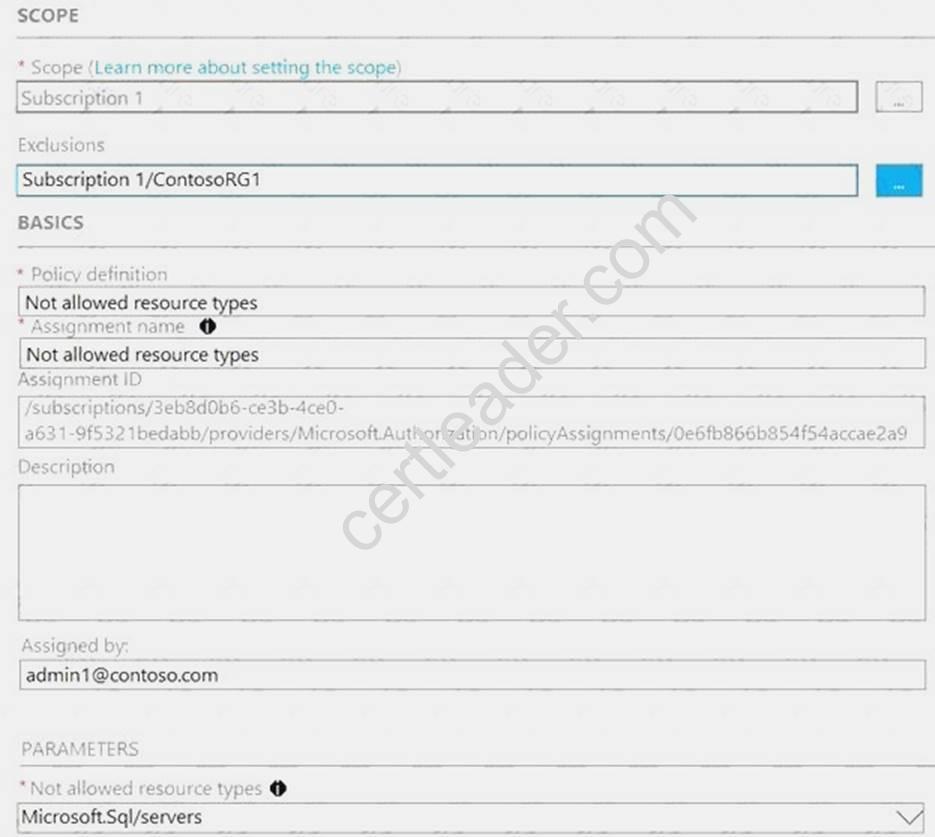
Which of the following statements are true? Which of the following statements are true?
- A. You can create Azure SQL servers in ContosoRG1.
- B. You are prevented from creating Azure SQL servers anywhere in Subscription 1.
- C. You are prevented from creating Azure SQL Servers in ContosoRG1 only.
- D. You can create Azure SQL servers in any resource group within Subscription 1.
Answer: A
Explanation: You are prevented from creating Azure SQL servers anywhere in Subscription 1 with the exception of ContosoRG1
NEW QUESTION 13
You have an Azure subscription named Subscription1.
You deploy a Linux virtual machine named VM1 to Subscription1. You need to monitor the metrics and the logs of VM1.
What should you use?
- A. LAD 3.0
- B. Azure Analysis Services
- C. the AzurePerformanceDiagnostics extension
- D. Azure HDInsight
Answer: C
Explanation: You can use extensions to configure diagnostics on your VMs to collect additional metric data.
The basic host metrics are available, but to see more granular and VM-specific metrics, you need to install the Azure diagnostics extension on the VM. The Azure diagnostics extension allows additional monitoring and diagnostics data to be retrieved from the VM.
References: https://docs.microsoft.com/en-us/azure/virtual-machines/linux/tutorial-monitoring
NEW QUESTION 14
You plan to deploy 20 Azure virtual machines by using an Azure Resource Manager template. The virtual machines will run the latest version of Windows Server 2021 Datacenter by using an Azure Marketplace image.
You need to complete the storageProfile section of the template.
How should you complete the storageProfile section? To answer, select the appropriate options in the answer area.
NOTE: Each correct selection is worth one point.
Answer:
Explanation: … "storageProfile": {
"imageReference": {
"publisher": "MicrosoftWindowsServer", "offer": "WindowsServer",
"sku": "2021-Datacenter", "version": "latest"
},
… References:
https://docs.microsoft.com/en-us/rest/api/compute/virtualmachines/createorupdate
NEW QUESTION 15
Click to expand each objective. To connect to the Azure portal, type https://portal.azure.com in the browser address bar.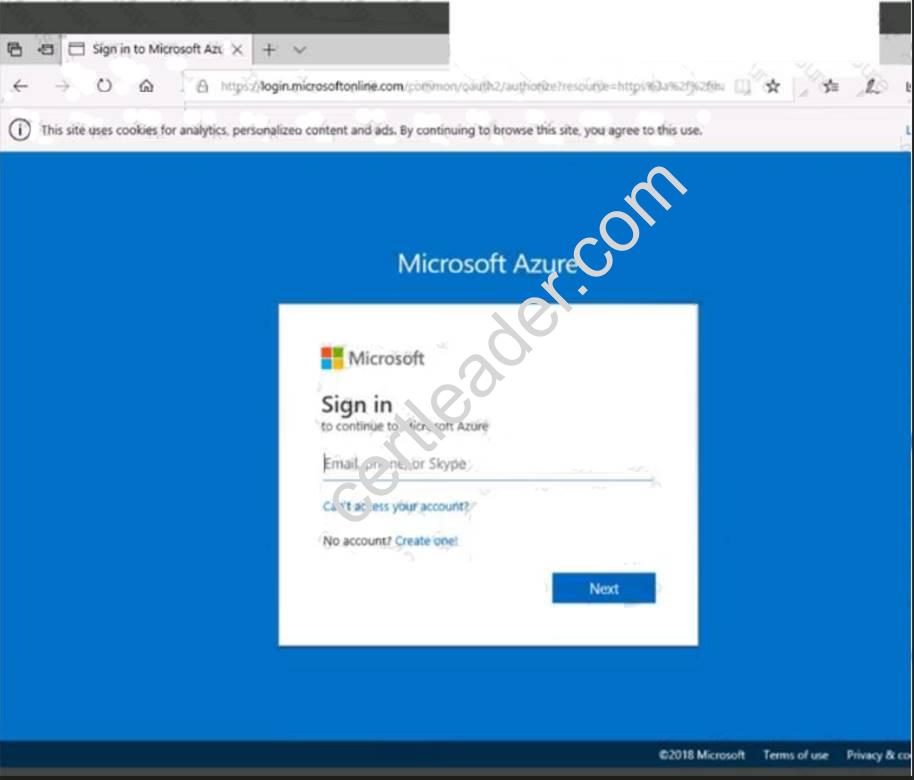
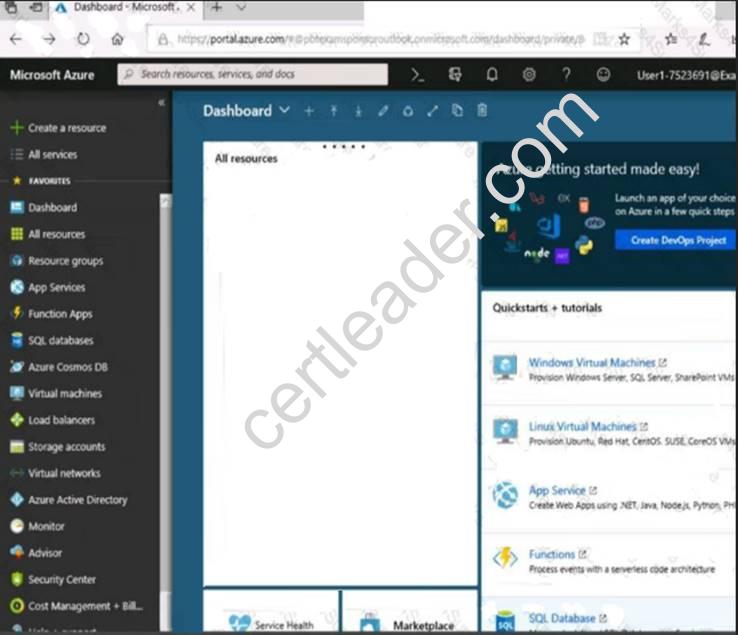
When you are finished performing all the tasks, click the ‘Next’ button.
Note that you cannot return to the lab once you click the ‘Next’ button. Scoring occur in the background while you complete the rest of the exam.
Overview
The following section of the exam is a lab. In this section, you will perform a set of tasks in a live environment. While most functionality will be available to you as it would be in a live environment, some functionality (e.g., copy and paste, ability to navigate to external websites) will not be possible by design.
Scoring is based on the outcome of performing the tasks stated in the lab. In other words, it doesn’t matter how you accomplish the task, if you successfully perform it, you will earn credit for that task.
Labs are not timed separately, and this exam may have more than one lab that you must complete. You can use as much time as you would like to complete each lab. But, you should manage your time appropriately to ensure that you are able to complete the lab(s) and all other sections of the exam in the time provided.
Please note that once you submit your work by clicking the Next button within a lab, you will NOT be able to return to the lab.
To start the lab
You may start the lab by clicking the Next button.
You plan to store media files in the rg1lod7523691n1 storage account.
You need to configure the storage account to store the media files. The solution must ensure that only users who have access keys can download the media files and that the files are accessible only over HTTPS.
What should you do from Azure portal?
Answer:
Explanation: We should create an Azure file share.
Step 1: In the Azure portal, select All services. In the list of resources, type Storage Accounts. As you begin typing, the list filters based on your input. Select Storage Accounts.
On the Storage Accounts window that appears.
Step 2: Locate the rg1lod7523691n1 storage account.
Step 3: On the storage account page, in the Services section, select Files.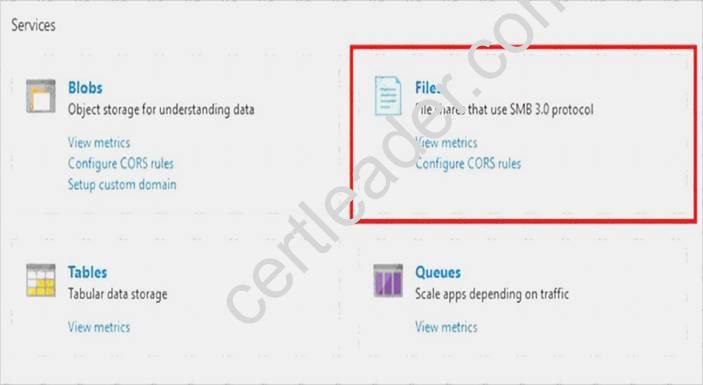
Step 4: On the menu at the top of the File service page, click + File share. The New file share page drops down.
Step 5: In Name type myshare. Click OK to create the Azure file share.
References: https://docs.microsoft.com/en-us/azure/storage/files/storage-how-to-use-files-portal
NEW QUESTION 16
Overview
The following section of the exam is a lab. In this section, you will perform a set of tasks in a live environment. While most functionality will be available to you as it would be in a live environment, some functionality (e.g., copy and paste, ability to navigate to external websites) will not be possible by design.
Scoring is based on the outcome of performing the tasks stated in the lab. In other words, it doesn’t matter how you accomplish the task, if you successfully perform it, you will earn credit for that task.
Labs are not timed separately, and this exam may have more than one lab that you must complete. You can use as much time as you would like to complete each lab. But, you should manage your time appropriately to ensure that you are able to complete the lab(s) and all other sections of the exam in the time provided.
Please note that once you submit your work by clicking the Next button within a lab, you will NOT be able to return to the lab.
To start the lab
You may start the lab by clicking the Next button.
You plan to connect several virtual machines to the VNET01-USEA2 virtual network.
In the Web-RGlod8095859 resource group, you need to create a virtual machine that uses the Standard_B2ms size named Web01 that runs Windows Server 2021. Web01 must be added to an availability set.
What should you do from the Azure portal?
Answer:
Explanation: Step 1. Choose Create a resource in the upper left-hand corner of the Azure portal.
Step 2. In the Basics tab, under Project details, make sure the correct subscription is selected and then choose Web-RGlod8095859 resource group
Step 3. Under Instance details type/select: Virtual machine name: Web01
Image: Windows Server 2021 Size: Standard_B2ms size Leave the other defaults.
Step 4. Finish the Wizard
NEW QUESTION 17
You have an Azure Active Directory (Azure AD) tenant named contosocloud.onmicrosoft.com. Your company has a public DNS zone for contoso.com.
You add contoso.com as a custom domain name to Azure AD. You need to ensure that Azure can verify the domain name. Which type of DNS record should you create?
- A. PTR
- B. MX
- C. NSEC3
- D. RRSIG
Answer: B
NEW QUESTION 18
You have an Azure subscription named Subscription1. Subscription1 contains a virtual machine named VM1. You install and configure a web server and a DNS server on VM1.
VM1 has the effective network security rules shown in the following exhibit.
Use the drop-down menus to select the answer choice that completes each statement based on the information presented in the graphic.
NOTE: Each correct selection is worth one point.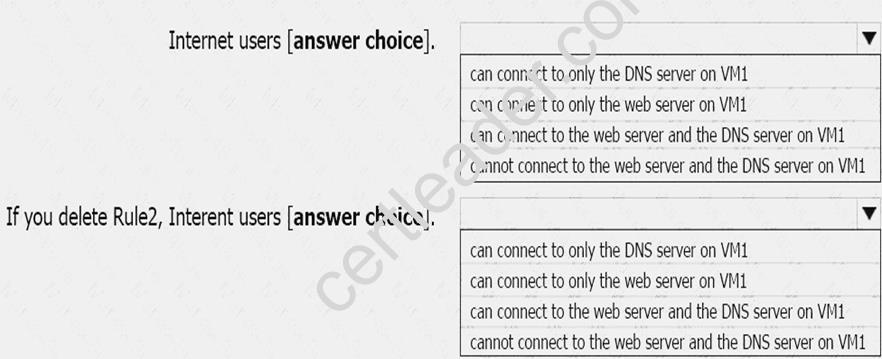
Answer:
Explanation: 
NEW QUESTION 19
Note: This question is part of a series of questions that present the same scenario. Each question in the series contains a unique solution that might meet the stated goals. Some question sets might have more than one correct solution, while others might not have a correct solution.
After you answer a question in this section, you will NOT be able to return to it. As a result, these questions will not appear in the review screen.
You have an Azure subscription named Subscription1. Subscription1 contains a resource group named RG1. RG1 contains resources that were deployed by using templates.
You need to view the date and time when the resources were created in RG1.
Solution: From the Subscriptions blade, you select the subscription, and then click Programmatic deployment. Does this meet the goal?
- A. Yes
- B. No
Answer: B
NEW QUESTION 20
You have an Azure subscription that contains 10 virtual machines.
You need to ensure that you receive an email message when any virtual machines are powered off, restarted, or deallocated.
What is the minimum number of rules and action groups that you require?
- A. three rules and three action groups
- B. one rule and one action group
- C. three rules and one action group
- D. one rule and three action groups
Answer: C
Explanation: An action group is a collection of notification preferences defined by the user. Azure Monitor and Service
Health alerts are configured to use a specific action group when the alert is triggered. Various alerts may use the same action group or different action groups depending on the user's requirements.
References: https://docs.microsoft.com/en-us/azure/monitoring-and-diagnostics/monitoring-action-groups
100% Valid and Newest Version AZ-100 Questions & Answers shared by prep-labs.com, Get Full Dumps HERE: https://www.prep-labs.com/dumps/AZ-100/ (New 106 Q&As)