It is impossible to pass VMware 2V0-622D exam without any help in the short term. Come to us soon and find the most advanced, correct and guaranteed . You will get a surprising result by our .
Online VMware 2V0-622D free dumps demo Below:
NEW QUESTION 1
What two debugging levels can a virtual machine be configured to? (Choose two.)
- A. Trivia
- B. Statistics
- C. Debugging
- D. Verbose
Answer: BC
NEW QUESTION 2
What is the logical and physical sector size for 512e disks?
- A. Logical Sector Size 512 Physical Sector Size 512
- B. Logical Sector Size 512 Physical Sector Size 4096
- C. Logical Sector Size 4096 Physical Sector Size 4096
- D. Logical Sector Size 2048 Physical Sector Size 512
Answer: B
NEW QUESTION 3
Which storage feature always requires the use of third-party software on ESXi?
- A. Hardware Acceleration for NAS devices
- B. VVOL
- C. Hardware Acceleration for Block Devices
- D. VM Storage Policies
Answer: A
Explanation: With NAS storage devices, the hardware acceleration integration is implemented through vendor-specific NAS plug-ins. These plug-ins are typically created by vendors and are distributed as VIB packages through a website. No claim rules are required for the NAS plug-ins to function.
Several tools for installing and upgrading VIB packages are available. They include the esxcli commands and vSphere Update Manager.
NEW QUESTION 4
Which are the two storage options for a Content Library when using the VMware vCenter Appliance? (Choose two.)
- A. FTP
- B. NFS
- C. CIFS
- D. VMFS
Answer: BD
Explanation: When you create a local library, you can store its contents on a datastore managed by the vCenter Server instance or on a remote file system.
Depending on the type of storage that you have, you can use Virtual Machine File System (VMFS) or Network File System (NFS) for storing content on a datastore.
NEW QUESTION 5
When using “Cluster resource percentage” for host failover capacity in vSphere HA Admission Control, the total resource requirements are calculated from which two values? (Choose two.)
- A. Total vCPUs assigned to each VM.
- B. Average CPU usage on each VM over time.
- C. Memory reservations on each VM.
- D. Total memory assigned to each VM.
- E. Average active memory on each VM over time.
- F. CPU reservations on each VM.
Answer: CF
NEW QUESTION 6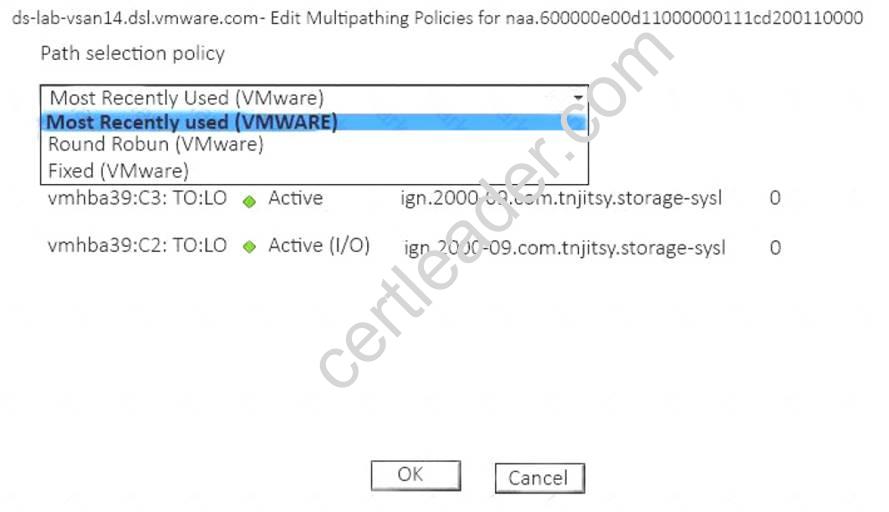
Examine the LUN properties that are shown in the exhibit. Which action should be taken to utilize all active paths?
- A. Change PSP to Most Recently Used
- B. No action require
- C. All paths are already utilized.
- D. Change PSP to Fixed.
- E. Change PSP to Round Robin.
Answer: D
Explanation: The host uses an automatic path selection algorithm rotating through all active paths when connecting to
active-passive arrays, or through all available paths when connecting to active-active arrays. RR is the default for a number of arrays and can be used with both active-active and active-passive arrays to implement load balancing across paths for different LUNs.
NEW QUESTION 7
Option available to enable Encrypted vMotion. (Choose two.)
- A. Enable
- B. Opportunistic
- C. Required
- D. Default
Answer: BC
NEW QUESTION 8
To prevent possible failures or issues during a vSphere upgrade, which component should be upgraded first?
- A. virtual machines
- B. datastores
- C. ESXi Hosts
- D. vCenter Server
Answer: A
NEW QUESTION 9
Which is the correct order for upgrading vSphere components?
- A. vCenter Server, ESXi hosts, VMware Tools, Virtual Machine hardware
- B. VMware Tools, Virtual Machine hardware, ESXi hosts, vCenter Server
- C. vCenter Server, Virtual Machine hardware, VMware tools, ESXi hosts
- D. ESXi hosts, vCenter Server, Virtual Machine hardware, VMware Tools
Answer: A
Explanation: Correct order is:
1 Back up your configuration 2 Upgrade vCenter Server
3 Upgrade ESXi hosts
4 Upgrade virtual machines and virtual appliances
NEW QUESTION 10
What are two requirements to enable EVC in a vSphere DRS cluster? (Choose two.)
- A. CPUs must be from the same vendor.
- B. CPUs must be in the same family and of the same speed.
- C. No VMs may be running in the cluster.
- D. EVC must use the lowest possible baseline supported by the hardware.
Answer: AD
NEW QUESTION 11
When installing vCenter Converter Standalone, why must an administrator perform a client-server installation instead of a local installation?
- A. to manage conversion tasks remotely
- B. to convert virtual machines as well as physical machines
- C. to allow installation of the Converter agent on remote source machines
- D. to hot clone physical or virtual machines
Answer: A
NEW QUESTION 12
Which two features require the use of Host Profiles? (Choose two.)
- A. vRealize Suite
- B. Auto Deploy
- C. shared storage
- D. Host Customization
Answer: BD
NEW QUESTION 13
Which two statements about vCenter HA are correct? (Choose two.)
- A. ESXi 5.5 or later is required.
- B. vCenter HA network latency between nodes must be less than 50 ms
- C. NFS datastore is supported.
- D. It must be deployed on a 3 ESXi host cluster with DRS enabled.
Answer: AC
Explanation: 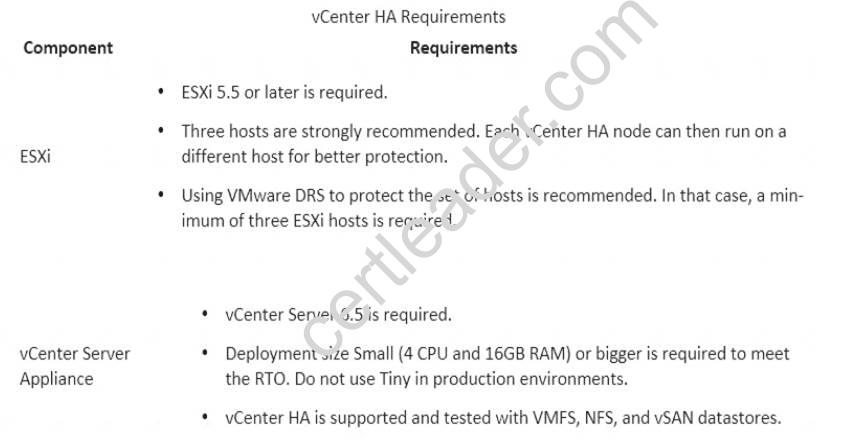
NEW QUESTION 14
What are two reasons why a datastore in a Storage DRS cluster cannot enter maintenance mode? (Choose two.)
- A. Storage latency is too high to allow Storage DRS initiate Storage vMotion.
- B. Rules prevent Storage DRS from making migration recommendations.
- C. Storage DRS is disabled on the virtual disk.
- D. Storage DRS is configured for a VMFS3 datastore.
Answer: BC
Explanation: Problem
A datastore in a datastore cluster cannot either maintenance mode. The Entering Maintenance Mode status remains at 1%.
Cause
One or more disks on the datastore cannot be migrated with Storage vMotion. This condition can occur in the following instances.
Storage DRS is disabled on the disk
Storage DRS rules prevent Storage DRS from making migration recommendations for the disk.
NEW QUESTION 15
What are three benefits of storage hardware acceleration? (Choose three.)
- A. faster VMFS metadata operations
- B. faster Storage vMotion
- C. faster virtual disk provisioning
- D. improved bandwidth
Answer: ABC
NEW QUESTION 16
Which two tasks should a vSphere administrator perform if the vmJc«rn«l log reports VMFS metadata errors? (Choose two.)
- A. reformat the datastore
- B. ignore the messages
- C. contact VMware technical support
- D. check the device with VOMA
Answer: CD
Explanation: https://docs.vmware.com/en/VMware-vSphere/6.0/com.vmware.vsphere.troubleshooting.doc/GUID-6F991DB5 VOMA = vSphere On-disk Metadata Analyser (dentify and fix incidents of metadata corruption that affect file systems or underlying logical volumes)
ProblemYou might need to check metadata consistency of a file system or a logical volume backing the file system when you experience problems with various functionalities on a VMFS datastore or a virtual flash resource. For example you might want to perform a metadata check if one of the following occurs:
You experience storage outages.
After you rebuild RAID or perform a disk replacement. You see metadata errors in the vmkernel.log file.
You are unable to access files on a VMFS.
You see corruption being reported for a datastore in events tabs of vCenter Server.
ResultsTo check metadata consistency, run VOMA from the CLI of an ESXi host. VOMA can be used to check and fix metadata inconsistency issues for a VMFS datastore or a virtual flash resource. To resolve errors reported by VOMA, consult VMware Support.
NEW QUESTION 17
A vSphere Administrator has received complaints that an MSCS cluster is failing over during vMotion operations.
What action would minimize migrations for only the MSCS VMs?
- A. Configure the VM DRS Automation level to override as Partially Automated.
- B. Configure the migration threshold to Conservative for the vSphere DRS cluster.
- C. Configure the vSphere DRS cluster to be Partially Automated.
- D. Change the pathing policy to Round Robin for MSCS RDMS.
Answer: A
NEW QUESTION 18
An administrator wants to ensure that any virtual machine added to a certain port group always has sufficient network resources. Network I/O Control version 3 has been enabled on the Distributed Switch.
Which three steps will achieve this objective? (Choose three.)
- A. Reserve bandwidth for virtual machine system traffic on the Distributed Switch Port Group.
- B. Edit the virtual machine’s Resource settings and set a reservation for virtual machine system traffic.
- C. Create a Network Resource Pool on the Distributed Switch and set a reservation quota.
- D. Reserve bandwidth for virtual machine system traffic on the Distributed Switch.
- E. Add the Network Resource Pool on the Distributed Switch Port Group.
Answer: CDE
NEW QUESTION 19
Virtual Volumes supports which three VMware features? (Choose three.)
- A. Instant Clones
- B. Linked Clones
- C. Distributed Resource Scheduler
- D. Storage Distributed Resource Scheduler
- E. vMotion
Answer: BCE
NEW QUESTION 20
In which scenario will vSphere DRS balance resources when set to Fully Automated?
- A. Hosts with shared or non-shared storage
- B. Hosts with only shared storage
- C. Hosts are part of a vSphere HA cluster
- D. Power Management is set to Balanced on hosts
Answer: B
100% Valid and Newest Version 2V0-622D Questions & Answers shared by Surepassexam, Get Full Dumps HERE: https://www.surepassexam.com/2V0-622D-exam-dumps.html (New 269 Q&As)