High quality of AI-100 download materials and test questions for Microsoft certification for IT professionals, Real Success Guaranteed with Updated AI-100 pdf dumps vce Materials. 100% PASS Designing and Implementing an Azure AI Solution exam Today!
Online AI-100 free questions and answers of New Version:
NEW QUESTION 1
You are designing an AI solution that will provide feedback to teachers who train students over the Internet. The students will be in classrooms located in remote areas. The solution will capture video and audio data of the students in the classrooms.
You need to recommend Azure Cognitive Services for the AI solution to meet the following requirements: Alert teachers if a student seems angry or distracted.
Identify each student in the classrooms for attendance purposes.
Allow the teachers to log the text of conversations between themselves and the students. Which Cognitive Services should you recommend?
- A. Computer Vision, Text Analytics, and Face API
- B. Video Indexer, Face API, and Text Analytics
- C. Computer Vision, Speech to Text, and Text Analytics
- D. Text Analytics, QnA Maker, and Computer Vision
- E. Video Indexer, Speech to Text, and Face API
Answer: E
Explanation:
Azure Video Indexer is a cloud application built on Azure Media Analytics, Azure Search, Cognitive Services (such as the Face API, Microsoft Translator, the Computer Vision API, and Custom Speech Service). It enables you to extract the insights from your videos using Video Indexer video and audio models.
Face API enables you to search, identify, and match faces in your private repository of up to 1 million people. The Face API now integrates emotion recognition, returning the confidence across a set of emotions for each face in the image such as anger, contempt, disgust, fear, happiness, neutral, sadness, and surprise. These emotions are understood to be cross-culturally and universally communicated with particular facial expressions.
Speech-to-text from Azure Speech Services, also known as speech-to-text, enables real-time transcription of audio streams into text that your applications, tools, or devices can consume, display, and take action on as command input. This service is powered by the same recognition technology that Microsoft uses for Cortana and Office products, and works seamlessly with the translation and text-to-speech.
NEW QUESTION 2
Note: This question is part of a series of questions that present the same scenario. Each question in the series contains a unique solution that might meet the stated goals. Some question sets might have more than one correct solution, while others might not have a correct solution.
After you answer a question in this section, you will NOT be able to return to it. As a result, these questions will not appear in the review screen.
You are developing an application that uses an Azure Kubernetes Service (AKS) cluster. You are troubleshooting a node issue.
You need to connect to an AKS node by using SSH.
Solution: You run the kubect1 command, and then you create an SSH connection.
Does this meet the goal?
- A. Yes
- B. No
Answer: B
NEW QUESTION 3
Note: This question is part of a series of questions that present the same scenario. Each question in the series contains a unique solution that might meet the stated goals. Some question sets might have more than one correct solution, while others might not have a correct solution.
After you answer a question, you will NOT be able to return to it. As a result, these questions will not appear in the review screen.
You have Azure IoT Edge devices that generate streaming data.
On the devices, you need to detect anomalies in the data by using Azure Machine Learning models. Once an anomaly is detected, the devices must add information about the anomaly to the Azure IoT Hub stream.
Solution: You deploy Azure Stream Analytics as an IoT Edge module. Does this meet the goal?
- A. Yes
- B. No
Answer: A
Explanation:
Available in both the cloud and Azure IoT Edge, Azure Stream Analytics offers built-in machine learning based anomaly detection capabilities that can be used to monitor the two most commonly occurring anomalies: temporary and persistent.
Stream Analytics supports user-defined functions, via REST API, that call out to Azure Machine Learning endpoints.
References:
https://docs.microsoft.com/en-us/azure/stream-analytics/stream-analytics-machine-learning-anomaly-detection
NEW QUESTION 4
Note: This question is part of a series of questions that present the same scenario. Each question in the series contains a unique solution that might meet the stated goals. Some question sets might have more than one correct solution, while others might not have a correct solution.
After you answer a question, you will NOT be able to return to it. As a result, these questions will not
appear in the review screen.
You have Azure IoT Edge devices that generate streaming data.
On the devices, you need to detect anomalies in the data by using Azure Machine Learning models. Once an anomaly is detected, the devices must add information about the anomaly to the Azure IoT Hub stream. Solution: You deploy Azure Functions as an IoT Edge module.
Does this meet the goal?
- A. Yes
- B. No
Answer: B
Explanation:
Instead use Azure Stream Analytics and REST API.
Note. Available in both the cloud and Azure IoT Edge, Azure Stream Analytics offers built-in machine learning based anomaly detection capabilities that can be used to monitor the two most commonly occurring anomalies: temporary and persistent.
Stream Analytics supports user-defined functions, via REST API, that call out to Azure Machine Learning endpoints.
References:
https://docs.microsoft.com/en-us/azure/stream-analytics/stream-analytics-machine-learning-anomaly-detection
NEW QUESTION 5
You plan to design a solution for an Al implementation that uses data from loT devices.
You need to recommend a data storage solution for the loT devices that meets the following requirements:
•Allow data to be queried in real-time as it streams into the solution.
•Provide the lowest amount of latency for loading data into the solution. What should you include in the recommendation?
- A. a Microsoft Azure SQL database that has In-Memory OLTP enabled
- B. a Microsoft Azure HDInsight R Server cluster
- C. a Microsoft Azure Table Storage solution
- D. a Microsoft Azure HDInsight Hadoop cluster
Answer: D
Explanation:
You can use HDInsight to process streaming data that's received in real time from a variety of devices. Internet of Things (IoT)
You can use HDInsight to build applications that extract critical insights from data. You can also use Azure Machine Learning on top of that to predict future trends for your business.
By combining enterprise-scale R analytics software with the power of Apache Hadoop and Apache Spark, Microsoft R Server for HDInsight gives you the scale and performance you need. Multi-threaded math libraries and transparent parallelization in R Server handle up to 1000x more data and up to 50x faster speeds than open-source R, which helps you to train more accurate models for better predictions.
References:
https://docs.microsoft.com/en-us/azure/hdinsight/hadoop/apache-hadoop-introduction
NEW QUESTION 6
Note: This question is part of a series of questions that present the same scenario. Each question in the series contains a unique solution that might meet the stated goals. Some question sets might have more than one correct solution, while others might not have a correct solution.
After you answer a question, you will NOT be able to return to it. As a result, these questions will not appear in the review screen.
You have Azure IoT Edge devices that generate streaming data.
On the devices, you need to detect anomalies in the data by using Azure Machine Learning models. Once an anomaly is detected, the devices must add information about the anomaly to the Azure IoT Hub stream. Solution: You expose a Machine Learning model as an Azure web service.
Does this meet the goal?
- A. Yes
- B. No
Answer: B
Explanation:
Instead use Azure Stream Analytics and REST API.
Note. Available in both the cloud and Azure IoT Edge, Azure Stream Analytics offers built-in machine learning based anomaly detection capabilities that can be used to monitor the two most commonly occurring anomalies: temporary and persistent.
Stream Analytics supports user-defined functions, via REST API, that call out to Azure Machine Learning endpoints.
References:
https://docs.microsoft.com/en-us/azure/stream-analytics/stream-analytics-machine-learning-anomaly-detection
NEW QUESTION 7
You have a database that contains sales data.
You plan to process the sales data by using two data streams named Stream1 and Stream2. Stream1 will be used for purchase order data. Stream2 will be used for reference data.
The reference data is stored in CSV files.
You need to recommend an ingestion solution for each data stream.
What two solutions should you recommend? Each correct answer is a complete solution.
NOTE: Each correct selection is worth one point.
- A. an Azure event hub for Stream1 and Azure Blob storage for Stream2
- B. Azure Blob storage for Stream1 and Stream2
- C. an Azure event hub for Stream1 and Stream2
- D. Azure Blob storage for Stream1 and Azure Cosmos DB for Stream2
- E. Azure Cosmos DB for Stream1 and an Azure event hub for Stream2
Answer: AB
Explanation:
Stream1 - Azure Event Stream2 - Blob Storage
Azure Event Hubs is a highly scalable data streaming platform and event ingestion service, capable of
receiving and processing millions of events per second. Event Hubs can process and store events, data, or telemetry produced by distributed software and devices. Data sent to an event hub can be transformed and stored using any real-time analytics provider or batching/storage adapters. Event Hubs provides publishsubscribe capabilities with low latency at massive scale, which makes it appropriate for big data scenarios.
Stream1, Stream2 - Blob Storage
Stream Analytics has first-class integration with Azure data streams as inputs from three kinds of resources: Azure Event Hubs
Azure IoT Hub Azure Blob storage
These input resources can live in the same Azure subscription as your Stream Analytics job or a different subscription.
References:
https://docs.microsoft.com/en-us/azure/architecture/data-guide/technology-choices/real-time-ingestion
NEW QUESTION 8
Your company has factories in 10 countries. Each factory contains several thousand IoT devices. The devices present status and trending data on a dashboard.
You need to ingest the data from the IoT devices into a data warehouse.
Which two Microsoft Azure technologies should you use? Each correct answer presents part of the solution.
NOTE: Each correct selection is worth one point.
- A. Azure Stream Analytics
- B. Azure Data Factory
- C. an Azure HDInsight cluster
- D. Azure Batch
- E. Azure Data Lake
Answer: CE
Explanation:
With Azure Data Lake Store (ADLS) serving as the hyper-scale storage layer and HDInsight serving as the Hadoop-based compute engine services. It can be used for prepping large amounts of data for insertion into a Data Warehouse
References:
https://www.blue-granite.com/blog/azure-data-lake-analytics-holds-a-unique-spot-in-the-modern-dataarchitectur
NEW QUESTION 9
You are designing an AI solution that will analyze media data. The data will be stored in Azure Blob storage. You need to ensure that the storage account is encrypted by using a key generated by the hardware security module (HSM) of your company.
Which three actions should you perform in sequence? To answer, move the appropriate actions from the list of actions to the answer area and arrange them in the correct order.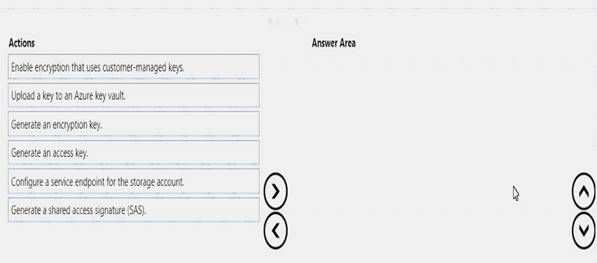
- A. Mastered
- B. Not Mastered
Answer: A
Explanation:
References:
https://docs.microsoft.com/en-us/azure/storage/common/storage-encryption-keys-portal https://docs.microsoft.com/en-us/azure/key-vault/key-vault-hsm-protected-keys
NEW QUESTION 10
You are designing an Al application that will perform real-time processing by using Microsoft Azure Stream Analytics.
You need to identify the valid outputs of a Stream Analytics job.
What are three possible outputs? Each correct answer presents a complete solution. NOTE: Each correct selection is worth one point.
- A. a Hive table in Azure HDInsight
- B. Azure SQL Database
- C. Azure Cosmos DB
- D. Azure Blob storage
- E. Azure Redis Cache
Answer: BCD
Explanation:
References:
https://docs.microsoft.com/en-us/azure/stream-analytics/stream-analytics-define-outputs
NEW QUESTION 11
You are designing an AI solution that will use IoT devices to gather data from conference attendees, and then later analyze the data. The IoT devices will connect to an Azure IoT hub.
You need to design a solution to anonymize the data before the data is sent to the IoT hub.
Which three actions should you perform in sequence? To answer, move the appropriate actions from the list of actions to the answer area and arrange them in the correct order.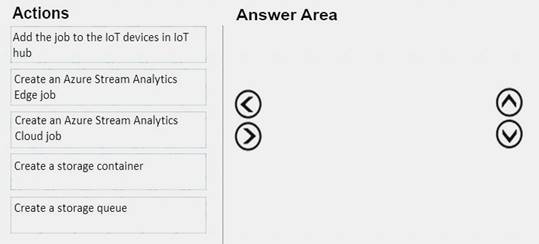
- A. Mastered
- B. Not Mastered
Answer: A
Explanation:
Step 1: Create a storage container
ASA Edge jobs run in containers deployed to Azure IoT Edge devices. Step 2: Create an Azure Stream Analytics Edge Job
Azure Stream Analytics (ASA) on IoT Edge empowers developers to deploy near-real-time analytical intelligence closer to IoT devices so that they can unlock the full value of device-generated data.
Scenario overview: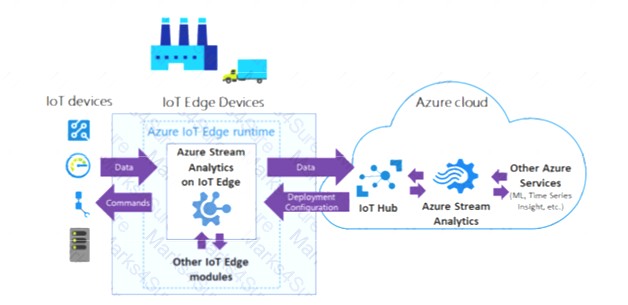
Step 3: Add the job to the IoT devices in IoT References:
https://docs.microsoft.com/en-us/azure/stream-analytics/stream-analytics-edge
NEW QUESTION 12
You are designing an AI solution in Azure that will perform image classification.
You need to identify which processing platform will provide you with the ability to update the logic over time. The solution must have the lowest latency for inferencing without having to batch.
Which compute target should you identify?
- A. graphics processing units (GPUs)
- B. field-programmable gate arrays (FPGAs)
- C. central processing units (CPUs)
- D. application-specific integrated circuits (ASICs)
Answer: B
Explanation:
FPGAs, such as those available on Azure, provide performance close to ASICs. They are also flexible and reconfigurable over time, to implement new logic.
NEW QUESTION 13
You design an AI solution that uses an Azure Stream Analytics job to process data from an Azure IoT hub. The IoT hub receives time series data from thousands of IoT devices at a factory.
The job outputs millions of messages per second. Different applications consume the messages as they are available. The messages must be purged.
You need to choose an output type for the job.
What is the best output type to achieve the goal? More than one answer choice may achieve the goal.
- A. Azure Event Hubs
- B. Azure SQL Database
- C. Azure Blob storage
- D. Azure Cosmos DB
Answer: D
Explanation:
Stream Analytics can target Azure Cosmos DB for JSON output, enabling data archiving and low-latency queries on unstructured JSON data.
References:
https://docs.microsoft.com/en-us/azure/stream-analytics/stream-analytics-documentdb-output
NEW QUESTION 14
You plan to implement a new data warehouse for a planned AI solution. You have the following information regarding the data warehouse:
•The data files will be available in one week.
•Most queries that will be executed against the data warehouse will be ad-hoc queries.
•The schemas of data files that will be loaded to the data warehouse will change often.
•One month after the planned implementation, the data warehouse will contain 15 TB of data. You need to recommend a database solution to support the planned implementation.
What two solutions should you include in the recommendation? Each correct answer is a complete solution. NOTE: Each correct selection is worth one point.
- A. Apache Hadoop
- B. Apache Spark
- C. a Microsoft Azure SQL database
- D. an Azure virtual machine that runs Microsoft SQL Server
Answer: AB
NEW QUESTION 15
Which RBAC role should you assign to the KeyManagers group?
- A. Cognitive Services Contributor
- B. Security Manager
- C. Cognitive Services User
- D. Security Administrator
Answer: A
Explanation:
References:
https://docs.microsoft.com/en-us/azure/role-based-access-control/built-in-roles
NEW QUESTION 16
You need to build a sentiment analysis solution that will use input data from JSON documents and PDF documents. The JSON documents must be processed in batches and aggregated.
Which storage type should you use for each file type? To answer, select the appropriate options in the answer area.
NOTE: Each correct selection is worth one point.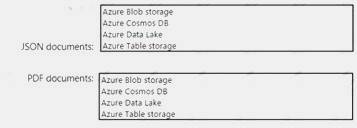
- A. Mastered
- B. Not Mastered
Answer: A
Explanation:
References:
https://docs.microsoft.com/en-us/azure/architecture/data-guide/big-data/batch-processing
NEW QUESTION 17
You are designing a solution that will use the Azure Content Moderator service to moderate user-generated content.
You need to moderate custom predefined content without repeatedly scanning the collected content. Which API should you use?
- A. Term List API
- B. Text Moderation API
- C. Image Moderation API
- D. Workflow API
Answer: A
Explanation:
The default global list of terms in Azure Content Moderator is sufficient for most content moderation needs. However, you might need to screen for terms that are specific to your organization. For example, you might
want to tag competitor names for further review.
Use the List Management API to create custom lists of terms to use with the Text Moderation API. The Text - Screen operation scans your text for profanity, and also compares text against custom and shared blacklists.
NEW QUESTION 18
You plan to build an application that will perform predictive analytics. Users will be able to consume the application data by using Microsoft Power Bl or a custom website.
You need to ensure that you can audit application usage. Which auditing solution should you use?
- A. Azure Storage Analytics
- B. Azure Application Insights
- C. Azure diagnostic logs
- D. Azure Active Directory (Azure AD) reporting
Answer: D
Explanation:
References:
https://docs.microsoft.com/en-us/azure/active-directory/reports-monitoring/concept-audit-logs
NEW QUESTION 19
Your company has 1,000 AI developers who are responsible for provisioning environments in Azure. You need to control the type, size, and location of the resources that the developers can provision. What should you use?
- A. Azure Key Vault
- B. Azure service principals
- C. Azure managed identities
- D. Azure Security Center
- E. Azure Policy
Answer: B
Explanation:
When an application needs access to deploy or configure resources through Azure Resource Manager in
Azure Stack, you create a service principal, which is a credential for your application. You can then delegate only the necessary permissions to that service principal.
References:
https://docs.microsoft.com/en-us/azure/azure-stack/azure-stack-create-service-principals
NEW QUESTION 20
You need to build an API pipeline that analyzes streaming data. The pipeline will perform the following:  Visual text recognition Audio transcription Sentiment analysis Face detection
Which Azure Cognitive Services should you use in the pipeline?
- A. Custom Speech Service
- B. Face API
- C. Text Analytics
- D. Video Indexer
Answer: D
Explanation:
Azure Video Indexer is a cloud application built on Azure Media Analytics, Azure Search, Cognitive Services (such as the Face API, Microsoft Translator, the Computer Vision API, and Custom Speech Service). It enables you to extract the insights from your videos using Video Indexer video and audio models described below:
Visual text recognition (OCR): Extracts text that is visually displayed in the video. Audio transcription: Converts speech to text in 12 languages and allows extensions.
Sentiment analysis: Identifies positive, negative, and neutral sentiments from speech and visual text. Face detection: Detects and groups faces appearing in the video.
References:
https://docs.microsoft.com/en-us/azure/media-services/video-indexer/video-indexer-overview
NEW QUESTION 21
You create an Azure Cognitive Services resource.
A data scientist needs to call the resource from Azure Logic Apps.
Which two values should you provide to the data scientist? Each correct answer presents part of the solution. NOTE: Each correct selection is worth one point.
- A. endpoint URL
- B. resource name
- C. access key
- D. resource group name
- E. subscription ID
Answer: DE
Explanation:
References:
https://social.technet.microsoft.com/wiki/contents/articles/36074.logic-apps-with-azure-cognitive-service.aspx
NEW QUESTION 22
You need to design an application that will analyze real-time data from financial feeds. The data will be ingested into Azure loT Hub. The data must be processed as quickly as possible in the order in which it is ingested.
Which service should you include in the design?
- A. Azure Event Hubs
- B. Azure Data Factory
- C. Azure Stream Analytics
- D. Apache Kafka
Answer: D
NEW QUESTION 23
You deploy an Azure bot.
You need to collect Key Performance Indicator (KPI) data from the bot. The type of data includes:
• The number of users interacting with the bot
• The number of messages interacting with the bot
• The number of messages on different channels received by the bot
• The number of users and messages continuously interacting with the bot What should you configure?
- A. Bot analytics
- B. Azure Monitor
- C. Azure Analysis Services
- D. Azure Application Insights
Answer: A
Explanation:
References:
https://docs.microsoft.com/en-us/azure/sql-database/saas-multitenantdb-adhoc-reporting
NEW QUESTION 24
You need to configure versioning and logging for Azure Machine Learning models. Which Machine Learning service application should you use?
- A. models
- B. activities
- C. experiments
- D. pipelines
- E. deployments
Answer: E
Explanation:
References:
https://docs.microsoft.com/en-us/azure/machine-learning/service/how-to-enable-logging#logging-for-deployed-
NEW QUESTION 25
Your company recently deployed several hardware devices that contain sensors.
The sensors generate new data on an hourly basis. The data generated is stored on-premises and retained for several years.
During the past two months, the sensors generated 300 GB of data.
You plan to move the data to Azure and then perform advanced analytics on the data. You need to recommend an Azure storage solution for the data.
Which storage solution should you recommend?
- A. Azure Queue storage
- B. Azure Cosmos DB
- C. Azure Blob storage
- D. Azure SQL Database
Answer: C
Explanation:
References:
https://docs.microsoft.com/en-us/azure/architecture/data-guide/technology-choices/data-storage
NEW QUESTION 26
......
Thanks for reading the newest AI-100 exam dumps! We recommend you to try the PREMIUM Downloadfreepdf.net AI-100 dumps in VCE and PDF here: https://www.downloadfreepdf.net/AI-100-pdf-download.html (101 Q&As Dumps)