We offers AZ-102 Dumps Questions. "Microsoft Azure Administrator Certification Transition", also known as AZ-102 exam, is a Microsoft Certification. This set of posts, Passing the AZ-102 exam with AZ-102 Exam Questions, will help you answer those questions. The AZ-102 Exam Questions covers all the knowledge points of the real exam. 100% real AZ-102 Exam Questions and revised by experts!
Online AZ-102 free questions and answers of New Version:
NEW QUESTION 1
You have an Azure Service Bus.
You need to implement a Service Bus queue that guarantees first in first-out (FIFO) delivery of messages.
What should you do?
- A. Set the Lock Duration setting to 10 seconds.
- B. Enable duplicate detection.
- C. Set the Max Size setting of the queue to 5 GB.
- D. Enable partitioning.
- E. Enable session
Answer: E
Explanation: Through the use of messaging sessions you can guarantee ordering of messages, that is first-in-firstout (FIFO) delivery of messages.
References:
https://docs.microsoft.com/en-us/azure/service-bus-messaging/service-bus-azure-and-service-busqueues- compared-contrasted
NEW QUESTION 2
Note: This question is part of a series of questions that present the same scenario. Each question in the series contains a unique solution that might meet the stated goals. Some question sets might have more than one correct solution, while others might not have a correct solution.
After you answer a question in this section, you will NOT be able to return to it. As a result, these questions will not appear in the review screen.
You have an Azure web app named Appl. App1 runs in an Azure App Service plan named Plan1. Plan1 is associated to the Free pricing tier.
You discover that App1 stops each day after running continuously for 60 minutes. You need to ensure that App1 can run continuously for the entire day.
Solution: You change the pricing tier of Plan1 to Basic. Does this meet the goal?
- A. Yes
- B. No
Answer: A
Explanation: The Free Tier provides 60 CPU minutes / day. This explains why App1 is stops. The Basic tier has no such cap.
References:
https://azure.microsoft.com/en-us/pricing/details/app-service/windows/
NEW QUESTION 3
You have an Azure Active Directory (Azure AD) tenant named Tenant1 and an Azure subscription named You enable Azure AD Privileged Identity Management.
You need to secure the members of the Lab Creator role. The solution must ensure that the lab creators request access when they create labs.
What should you do first?
- A. From Azure AD Privileged Identity Management, edit the role settings for Lab Creator.
- B. From Subscription1 edit the members of the Lab Creator role.
- C. From Azure AD Identity Protection, creates a user risk policy.
- D. From Azure AD Privileged Identity Management, discover the Azure resources of Conscriptio
Answer: A
Explanation: As a Privileged Role Administrator you can: Enable approval for specific roles
Specify approver users and/or groups to approve requests View request and approval history for all privileged roles References:
https://docs.microsoft.com/en-us/azure/active-directory/privileged-identity-management/pimconfigure
NEW QUESTION 4
DRAG DROP
You need to prepare the New York office infrastructure for the migration of the on-premises virtual machines to Azure.
Which four actions you perform in sequence? To answer, move the appropriate actions from the list of actions to the answer area and arrange them in the correct order.
Answer:
Explanation: Box 1:
From the Azure portal, download the OVF file.
In the vCenter Server, import the Collector appliance as a virtual machine using the Deploy OVF Template wizard.
In vSphere Client console, click File > Deploy OVF Template.
In the Deploy OVF Template Wizard > Source, specify the location for the .ovf file. Box 2: From VM1, connect to the collector virtual machine
After you've created the Collector virtual machine, connect to it and run the Collector. Box 3: From the ASRV1 blade in the Azure portal, select a protection goal.
Box 4: From VM1, register the configuration server. Register the configuration server in the vault
Scenario: The Azure infrastructure and the on-premises infrastructure and the on-premises infrastructure must be prepared for the migration of the VMware virtual machines to Azure. References:
Migrate Your Virtual Machines to Microsoft Azure, Includes guidance for optional data migration, Proof of Concept guide, September 2021 https://azuremigrate.blob.core.windows.net/publicpreview/Azure%20Migrate%20-
%20Preview%20User%20Guide.pdf
NEW QUESTION 5
SIMULATION
Click to expand each objective. To connect to the Azure portal, type https://portal.azure.com in the browser address bar.


When you are finished performing all the tasks, click the ‘Next’ button.
Note that you cannot return to the lab once you click the ‘Next’ button. Scoring occur in the background while you complete the rest of the exam.
Overview
The following section of the exam is a lab. In this section, you will perform a set of tasks in a live environment. While most functionality will be available to you as it would be in a live environment, some functionality (e.g., copy and paste, ability to navigate to external websites) will not be possible by design.
Scoring is based on the outcome of performing the tasks stated in the lab. In other words, it doesn’t matter how you accomplish the task, if you successfully perform it, you will earn credit for that task. Labs are not timed separately, and this exam may have more than one lab that you must complete. You can use as much time as you would like to complete each lab. But, you should manage your time appropriately to ensure that you are able to complete the lab(s) and all other sections of the exam in the time provided.
Please note that once you submit your work by clicking the Next button within a lab, you will NOT be able to return to the lab.
To start the lab
You may start the lab by clicking the Next button.
You plan to store media files in the rg1lod7523691n1 storage account.
You need to configure the storage account to store the media files. The solution must ensure that only users who have access keys can download the media files and that the files are accessible only over HTTPS.
What should you do from Azure portal?
Answer:
Explanation: We should create an Azure file share.
Step 1: In the Azure portal, select All services. In the list of resources, type Storage Accounts. As you begin typing, the list filters based on your input. Select Storage Accounts.
On the Storage Accounts window that appears.
Step 2: Locate the rg1lod7523691n1 storage account.
Step 3: On the storage account page, in the Services section, select Files.
Step 4: On the menu at the top of the File service page, click + File share. The New file share page drops down.
Step 5: In Name type myshare. Click OK to create the Azure file share.
References: https://docs.microsoft.com/en-us/azure/storage/files/storage-how-to-use-files-portal
NEW QUESTION 6
SIMULATION
Click to expand each objective. To connect to the Azure portal, type https://portal.azure.com in the browser address bar.
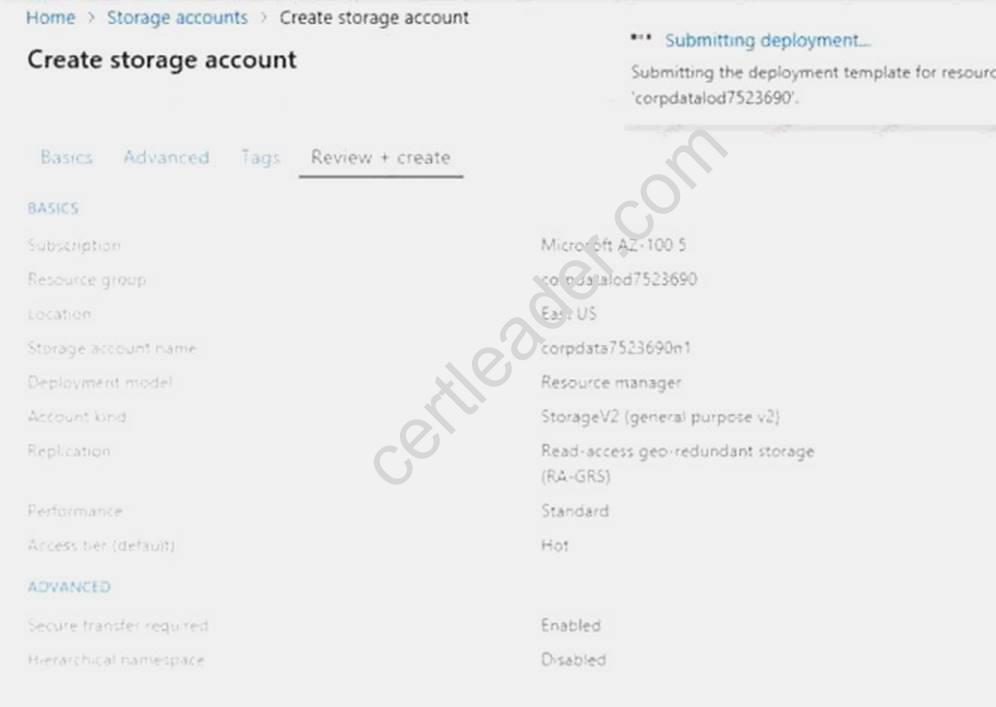


When you are finished performing all the tasks, click the ‘Next’ button.
Note that you cannot return to the lab once you click the ‘Next’ button. Scoring occur in the background while you complete the rest of the exam.
Overview
The following section of the exam is a lab. In this section, you will perform a set of tasks in a live environment. While most functionality will be available to you as it would be in a live environment, some functionality (e.g., copy and paste, ability to navigate to external websites) will not be possible by design. Scoring is based on the outcome of performing the tasks stated in the lab. In other words, it doesn’t matter how you accomplish the task, if you successfully perform it, you will earn credit for that task.
Labs are not timed separately, and this exam may have more than one lab that you must complete. You can use as much time as you would like to complete each lab. But, you should manage your time appropriately to ensure that you are able to complete the lab(s) and all other sections of the exam in the time provided.
Please note that once you submit your work by clicking the Next button within a lab, you will NOT be able to return to the lab.
To start the lab
You may start the lab by clicking the Next button.
You need to deploy two Azure virtual machines named VM1003a and VM1003b based on the Ubuntu Server 17.10 image. The deployment must meet the following requirements:
Provide a Service Level Agreement (SLA) of 99.95 percent availability. Use managed disks.
What should you do from the Azure portal?
Answer:
Explanation: 1. Open the Azure portal.
2. On the left menu, select All resources. You can sort the resources by Type to easily find your images.
3. Select the image you want to use from the list. The image Overview page opens.
4. Select Create VM from the menu.
5. Enter the virtual machine information.
Select VM1003a as the name for the first Virtual machine.
The user name and password entered here will be used to log in to the virtual machine. When complete, select OK. You can create the new VM in an existing resource group, or choose Create new to create a new resource group to store the VM.
6. Select a size for the VM. To see more sizes, select View all or change the Supported disk type filter.
7. Under Settings, make changes as necessary and select OK.
8. On the summary page, you should see your image name listed as a Private image. Select Ok to start the virtual machine deployment.
Repeat the procedure for the second VM and name it VM1003b.
References: https://docs.microsoft.com/en-us/azure/virtual-machines/windows/create-vmgeneralized- managed
NEW QUESTION 7
HOT SPOT
You have an Azure subscription named Subscription1. Subscription1 contains two Azure virtual machines named VM1 and VM2. VM1 and VM2 run Windows Server 2021.
VM1 is backed up daily by Azure Backup without using the Azure Backup agent. VM1 is affected by ransomware that encrypts data.
You need to restore the latest backup of VM1.
To which location can you restore the backup? To answer, select the appropriate options in the answer area.
NOTE: Each correct selection is worth one point.
Answer:
Explanation: Box 1: VM1 only
To restore files or folders from the recovery point, go to the virtual machine and choose the desired recovery point.
Box 2: A new Azure virtual machine only
On the Restore configuration blade, you have two choices: Create virtual machine
Restore disks References:
https://docs.microsoft.com/en-us/azure/backup/backup-azure-restore-files-from-vm https://docs.microsoft.com/en-us/azure/backup/backup-azure-arm-restore-vms
NEW QUESTION 8
SIMULATION
Click to expand each objective. To connect to the Azure portal, type https://portal.azure.com in the browser address bar.


When you are finished performing all the tasks, click the ‘Next’ button.
Note that you cannot return to the lab once you click the ‘Next’ button. Scoring occur in the background while you complete the rest of the exam.
Overview
The following section of the exam is a lab. In this section, you will perform a set of tasks in a live environment. While most functionality will be available to you as it would be in a live environment, some functionality (e.g., copy and paste, ability to navigate to external websites) will not be possible by design. Scoring is based on the outcome of performing the tasks stated in the lab. In other words, it doesn’t matter how you accomplish the task, if you successfully perform it, you will earn credit for that task.
Labs are not timed separately, and this exam may have more than one lab that you must complete. You can use as much time as you would like to complete each lab. But, you should manage your time appropriately to ensure that you are able to complete the lab(s) and all other sections of the exam in the time provided.
Please note that once you submit your work by clicking the Next button within a lab, you will NOT be able to return to the lab.
To start the lab
You may start the lab by clicking the Next button.
Your on-premises network uses an IP address range of 131.107.2.0 to 131.107.2.255. You need to ensure that only devices from the on-premises network can connect to the rg1lod7523691n1 storage account.
What should you do from the Azure portal?
Answer:
Explanation: Step 1: Navigate to the rg1lod7523691n1 storage account.
Step 2: Click on the settings menu called Firewalls and virtual networks. Step 3: Ensure that you have elected to allow access from 'Selected networks'.
Step 4: To grant access to an internet IP range, enter the address range of 131.107.2.0 to 131.107.2.255 (in CIDR format) under Firewall, Address Ranges.
References: https://docs.microsoft.com/en-us/azure/storage/common/storage-network-security
NEW QUESTION 9
You need to move the blueprint files to Azure. What should you do?
- A. Generate a shared access signature (SAS). Map a drive, and then copy the files by using File Explorer.
- B. Use the Azure Import/Export service.
- C. Generate an access ke
- D. Map a drive, and then copy the files by using File Explorer.
- E. Use Azure Storage Explorer to copy the file
Answer: D
Explanation: Azure Storage Explorer is a free tool from Microsoft that allows you to work with Azure Storage data on Windows, macOS, and Linux. You can use it to upload and download data from Azure blob storage.
Scenario:
Planned Changes include: move the existing product blueprint files to Azure Blob storage. Technical Requirements include: Copy the blueprint files to Azure over the Internet.
References: https://docs.microsoft.com/en-us/azure/machine-learning/team-data-scienceprocess/move-data-to-azure-blob-using-azure-storage-explorer
NEW QUESTION 10
Note: This questions is part of a series of questions that present the same scenario. Each questions in the series contains a unique solution that might meet the stated goals. Some questions sets might have more than one correct solution, while others might not have a correct solution. After you answer a questions in this section, you will NOT be able to return to it. As a result, these questions will not appear in the review screen.
You have an Azure virtual machine named VM1. VM1 was deployed by using a custom Azure Resource Manager template named ARM1.json.
You receive a notification that VM1 will be affected by maintenance. You need to move VM1 to a different host immediately.
Solution: From the Update management blade, you click enable. Does this meet the goal?
- A. Yes
- B. No
Answer: B
Explanation: You would need to Redeploy the VM.
References: https://docs.microsoft.com/en-us/azure/virtual-machines/windows/redeploy-to-newnode
NEW QUESTION 11
Note: This question is part of a series of questions that present the same scenario. Each question in the series contains a unique solution that might meet the stated goals. Some question sets might have more than one correct solution, while others might not have a correct solution.
After you answer a question in this section, you will NOT be able to return to it. As a result, these Questions will not appear in the review screen.
You have an Azure subscription named Subscription1. Subscription1 contains a resource group named RG1. RG1 contains resources that were deployed by using templates.
You need to view the date and time when the resources were created in RG1.
Solution: From the Subscriptions blade, you select the subscription, and then click Resource providers.
Does this meet the goal?
- A. Yes
- B. No
Answer: B
NEW QUESTION 12
DRAG DROP
You are developing an Azure web app named WebApp1. WebApp1 uses an Azure App Service plan named Plan1 that uses the B1 pricing tier.
You need to configure WebApp1 to add additional instances of the app when CPU usage exceeds 70 percent for 10 minutes.
Which three actions should you perform in sequence? To answer, move the appropriate actions from the list of actions to the answer area and arrange them in the correct order.
Answer:
Explanation: Box 1: From the Scale out (App Service Plan) settings blade, change the pricing tier The B1 pricing tier only allows for 1 core. We must choose another pricing tier. Box 2: From the Scale out (App Service Plan) settings blade, enable autoscale
Log in to the Azure portal at http://portal.azure.com Navigate to the App Service you would like to autoscale. Select Scale out (App Service plan) from the menu
Click on Enable autoscale. This activates the editor for scaling rules.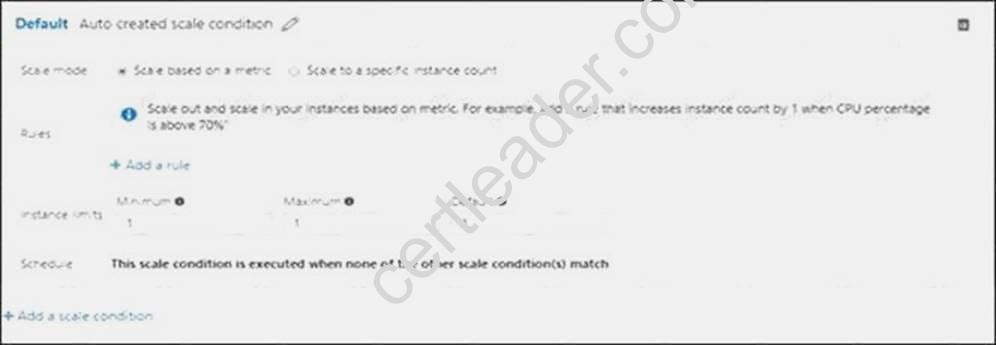
Box 3: From the Scale mode to Scale based on metric, add a rule, and set the instance limits.
Click on Add a rule. This shows a form where you can create a rule and specify details of the scaling. References:
https://azure.microsoft.com/en-us/pricing/details/app-service/windows/ https://blogs.msdn.microsoft.com/hsirtl/2021/07/03/autoscaling-azure-web-apps/
NEW QUESTION 13
Note: This questions is part of a series of questions that present the same scenario. Each question in the series contains a unique solution that might meet the stated goals. Some question sets might have more than one correct solution, while others might not have a correct solution.
After you answer a question in this section, you will NOT be able to return to it. As a result, these questions will not appear in the review screen.
You have an Azure subscription named Subscription1. Subscription1 contains a resource group named RG1. RG1 contains resources that were deployed by using templates.
You need to view the date and time when the resources were created in RG1.
Solution: From the Subscriptions blade, you select the subscription, and then click Programmatic deployment.
Does this meet the goal?
- A. Yes
- B. No
Answer: B
NEW QUESTION 14
You have an on-premises network that contains a Hyper-V host named Host1. Host1 runs Windows Server 2021 and hosts 10 virtual machines that run Windows Server 2021.
You plan to replicate the virtual machines to Azure by using Azure Site Recovery. You create a Recovery Services vault named ASR1 and a Hyper-V site named Site1. You need to add Host1 to ASR1.
What should you do?
- A. Download the installation file for the Azure Site Recovery Provide
- B. Download the vault registration key.Install the Azure Site Recovery Provider on Host1 and register the server.
- C. Download the installation file for the Azure Site Recovery Provide
- D. Download the storage account key.Install the Azure Site Recovery Provider on Host1 and register the server.
- E. Download the installation file for the Azure Site Recovery Provide
- F. Download the vault registration key.Install the Azure Site Recovery Provider on each virtual machine and register the virtual machines.
- G. Download the installation file for the Azure Site Recovery Provide
- H. Download the storage account key.Install the Azure Site Recovery Provider on each virtual machine and register the virtual machine
Answer: A
Explanation: Download the Vault registration key. You need this when you install the Provider. The key is valid for five days after you generate it.
Install the Provider on each VMM server. You don't need to explicitly install anything on Hyper-V hosts.
Incorrect Answers:
B, D: Use the Vault Registration Key, not the storage account key. References:
https://docs.microsoft.com/en-us/azure/site-recovery/migrate-tutorial-on-premises-azure
NEW QUESTION 15
HOT SPOT
You have an Azure subscription named Subscroption1. In Subscription1, you create an alert rule named Alert1.
The Alert1 action group is configured as shown in the following exhibit.
Alert1 alert criteria is triggered every minute.
Use the drop-down menus to select the answer choice that completes each statement based on the information presented in the graphic.
NOTE: Each correct selection is worth one point.
Answer:
Explanation: Box 1: 60
One alert per minute will trigger one email per minute. Box 2: 12
No more than 1 SMS every 5 minutes can be send, which equals 12 per hour.
Note: Rate limiting is a suspension of notifications that occurs when too many are sent to a particular phone number, email address or device. Rate limiting ensures that alerts are manageable and actionable.
The rate limit thresholds are:
SMS: No more than 1 SMS every 5 minutes. Voice: No more than 1 Voice call every 5 minutes. Email: No more than 100 emails in an hour. Other actions are not rate limited.
References:
https://github.com/MicrosoftDocs/azure-docs/blob/master/articles/monitoring-anddiagnostics/ monitoring-overview-alerts.md
NEW QUESTION 16
HOT SPOT
You have an Azure subscription named Subscription1.
In Subscription1, you create an Azure file share named share1.
You create a shared access signature (SAS) named SAS1 as shown in the following exhibit.
To answer, select the appropriate options in the answer area. NOTE: Each correct selection is worth one point.
Answer:
Explanation: Box 1: Will be prompted for credentials
Azure Storage Explorer is a standalone app that enables you to easily work with Azure Storage data on Windows, macOS, and Linux. It is used for connecting to and managing your Azure storage accounts.
Box 2: Will have read, write, and list access
The net use command is used to connect to file shares. References:
https://docs.microsoft.com/en-us/azure/storage/common/storage-dotnet-shared-access-signaturepart- https://docs.microsoft.com/en-us/azure/vs-azure-tools-storage-manage-with-storageexplorer? tabs=windows
NEW QUESTION 17
You plan to deploy an application getaway named appgw1015 to load balance IP traffic to the Azure virtual machines connected to subnet0.
You need to configure a virtual network named VNET1015 to support the planned application gateway.
What should you do from the Azure portal?
Answer:
Explanation: Step 1:
Click Networking, Virtual Network, and select VNET1015. Step 2:
Click Subnets, and Click +Add on the VNET1015 - Subnets pane that appears. Step 3:
On the Subnets page, click +Gateway subnet at the top to open the Add subnet page.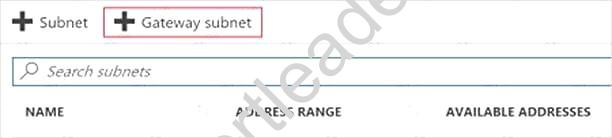
Step 4:
Locate subnet0 and add it. References:
https://docs.microsoft.com/en-us/azure/vpn-gateway/vpn-gateway-howto-site-to-site-resourcemanager- portal
NEW QUESTION 18
HOT SPOT
You need to configure the Device settings to meet the technical requirements and the user requirements.
Which two settings should you modify? To answer, select the appropriate settings in the answer area.
Answer:
Explanation:
Box 1: Selected
Only selected users should be able to join devices Box 2: Yes
Require Multi-Factor Auth to join devices. From scenario:
Ensure that only users who are part of a group named Pilot can join devices to Azure AD
Ensure that when users join devices to Azure Active Directory (Azure AD), the users use a mobile phone to verify their identity.
Recommend!! Get the Full AZ-102 dumps in VCE and PDF From 2passeasy, Welcome to Download: https://www.2passeasy.com/dumps/AZ-102/ (New 195 Q&As Version)