Act now and download your AZ-102 Exam Dumps today! Do not waste time for the worthless AZ-102 Exam Questions tutorials. Download AZ-102 Exam Questions with real questions and answers and begin to learn AZ-102 Exam Questions with a classic professional.
Check AZ-102 free dumps before getting the full version:
NEW QUESTION 1
Which blade should you instruct the finance department auditors to use?
- A. invoices
- B. partner information
- C. cost analysis
- D. External services
Answer: A
NEW QUESTION 2
HOT SPOT
You have an Azure Migrate project that has the following assessment properties: Target location: East US
Storage redundancy: Locally redundant. Comfort factor: 2.0
Performance history: 1 month Percentile utilization: 95th
Pricing tier: Standard Offer: Pay as you go
You discover the following two virtual machines:
A virtual machine named VM1 that runs Windows Server 2021 and has 10 CPU cores at 20 percent utilization
A virtual machine named VM2 that runs Windows Server 2012 and has four CPU cores at 50 percent utilization
How many CPU cores will Azure Migrate recommend for each virtual machine? To answer, select the appropriate options in the answer area.
NOTE: Each correct selection is worth one point.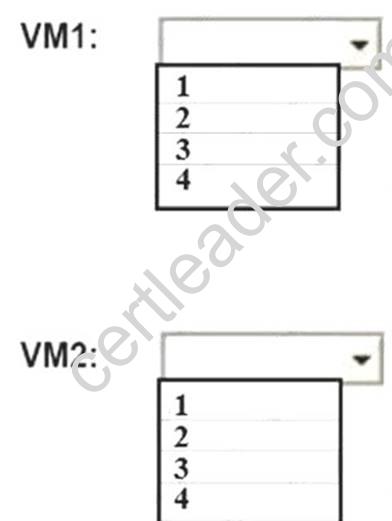
Answer:
Explanation: Box 2: 4
4 *0.50 * 0.95* 2 = 3.8
Note: The number of cores in the machines must be equal to or less than the maximum number of cores (128 cores) supported for an Azure VM.
If performance history is available, Azure Migrate considers the utilized cores for comparison. If a comfort factor is specified in the assessment settings, the number of utilized cores is multiplied by the comfort factor.
If there's no performance history, Azure Migrate uses the allocated cores, without applying the comfort factor.
References:
https://docs.microsoft.com/en-us/azure/migrate/concepts-assessment-calculation
NEW QUESTION 3
You have an Azure subscription that contains a storage account named account1.
You plan to upload the disk files of a virtual machine to account1 from your on-premises network. The on-premises network uses a public IP address space of 131.107.1.0/24.
You plan to use the disk files to provision an Azure virtual machine named VM1. VM1 will be attached to a virtual network named VNet1. VNet1 uses an IP address space of 192.168.0.0/24. You need to configure account1 to meet the following requirements:
Ensure that you can upload the disk files to account1. Ensure that you can attach the disks to VM1. Prevent all other access to account1.
Which two actions should you perform? Each correct selection presents part of the solution. NOTE: Each correct selection is worth one point.
- A. From the Firewalls and virtual networks blade of account1, add the 131.107.1.0/24 IP address range.
- B. From the Firewalls and virtual networks blade of account1, select Selected networks.
- C. From the Firewalls and virtual networks blade of acount1, add VNet1.
- D. From the Firewalls and virtual networks blade of account1, select Allow trusted Microsoft services toaccess this storage account.
- E. From the Service endpoints blade of VNet1, add a service endpoin
Answer: BE
Explanation: B: By default, storage accounts accept connections from clients on any network. To limit access to selected networks, you must first change the default action.
Azure portal
Navigate to the storage account you want to secure.
Click on the settings menu called Firewalls and virtual networks.
To deny access by default, choose to allow access from 'Selected networks'. To allow traffic from all networks, choose to allow access from 'All networks'.
Click Save to apply your changes.
E: Grant access from a Virtual Network
Storage accounts can be configured to allow access only from specific Azure Virtual Networks. By enabling a Service Endpoint for Azure Storage within the Virtual Network, traffic is ensured an optimal route to the Azure Storage service. The identities of the virtual network and the subnet are also transmitted with each request.
References: https://docs.microsoft.com/en-us/azure/storage/common/storage-network-security
NEW QUESTION 4
Your company registers a domain name of contoso.com.
You create an Azure DNS named contoso.com and then you add an A record to the zone for a host named www that has an IP address of 131.107.1.10.
You discover that Internet hosts are unable to resolve www.contoso.com to the 131.107.1.10 IP address.
You need to resolve the name resolution issue.
Solution: You modify the SOA record in the contoso.com zone Does this meet the goal?
- A. Yes
- B. No
Answer: B
Explanation: Modify the NS record, not the SOA record.
Note: The SOA record stores information about the name of the server that supplied the data for the zone; the administrator of the zone; the current version of the data file; the number of seconds a secondary name server should wait before checking for updates; the number of seconds a secondary name server should wait before retrying a failed zone transfer; the maximum number of seconds that a secondary name server can use data before it must either be refreshed or expire; and a default number of seconds for the time-to-live file on resource records.
References: https://searchnetworking.techtarget.com/definition/start-of-authority-record
NEW QUESTION 5
HOT SPOT
You need to prepare the environment to implement the planned changes for Server2. What should you do? To answer, select the appropriate options in the answer area. NOTE: Each correct selection is worth one point.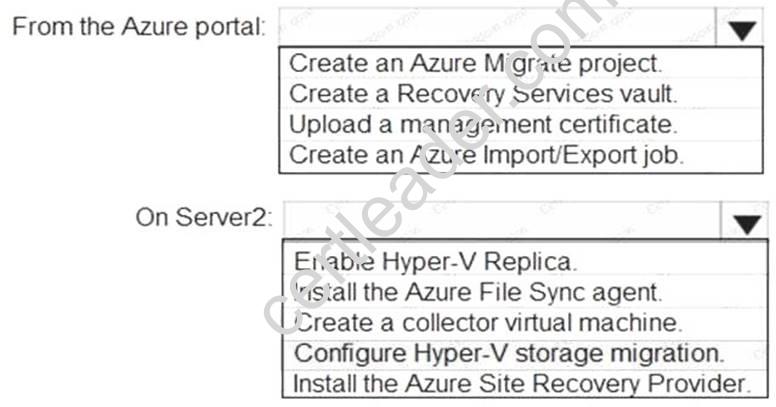
Answer:
Explanation: Box 1: Create a Recovery Services vault
Create a Recovery Services vault on the Azure Portal. Box 2: Install the Azure Site Recovery Provider
Azure Site Recovery can be used to manage migration of on-premises machines to Azure. Scenario: Migrate the virtual machines hosted on Server1 and Server2 to Azure.
Server2 has the Hyper-V host role. References:
https://docs.microsoft.com/en-us/azure/site-recovery/migrate-tutorial-on-premises-azure
Case Study: 8
Mix Questions Set C (Evaluate and perform server migration to Azure)
NEW QUESTION 6
You need to meet the technical requirement for VM4. What should you create and configure?
- A. an Azure Notification Hub
- B. an Azure Event Hub
- C. an Azure Logic App
- D. an Azure services Bus
Answer: B
Explanation: Scenario: Create a workflow to send an email message when the settings of VM4 are modified. You can start an automated logic app workflow when specific events happen in Azure resources or third-party resources. These resources can publish those events to an Azure event grid. In turn, the event grid pushes those events to subscribers that have queues, webhooks, or event hubs as endpoints. As a subscriber, your logic app can wait for those events from the event grid before running automated workflows to perform tasks - without you writing any code.
References:
https://docs.microsoft.com/en-us/azure/event-grid/monitor-virtual-machine-changes-event-gridlogic- app
NEW QUESTION 7
You have an Azure subscription that contains the resources in the following table.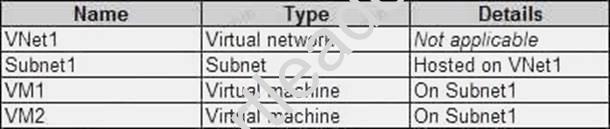
VM1 and VM2 are deployed from the same template and host line-of-business applications accessed by using Remote Desktop. You configure the network security group (NSG) shown in the exhibit. (Click the Exhibit button.)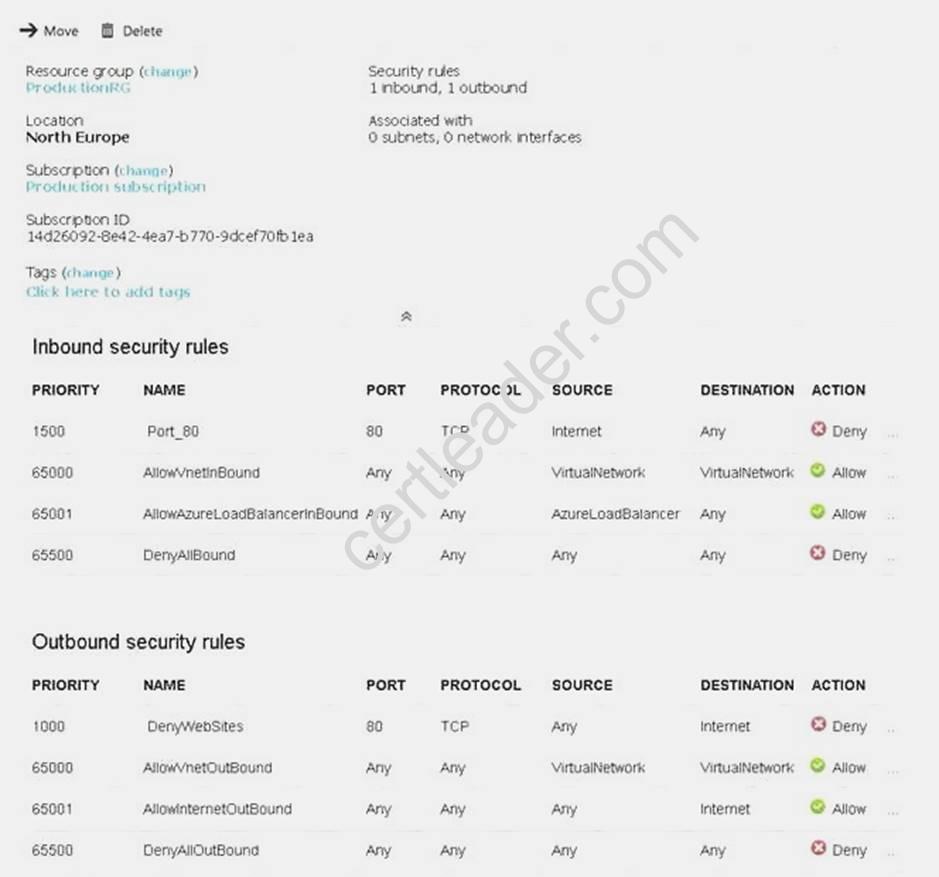
You need to prevent users of VM1 and VM2 from accessing websites on the Internet. What should you do?
- A. Associate the NSG to Subnet1.
- B. Disassociate the NSG from a network interface.
- C. Change the DenyWebSites outbound security rule.
- D. Change the Port_80 inbound security rul
Answer: A
Explanation: You can associate or dissociate a network security group from a network interface or subnet.
The NSG has the appropriate rule to block users from accessing the Internet. We just need to associate it with Subnet1.
References: https://docs.microsoft.com/en-us/azure/virtual-network/manage-network-securitygroup
NEW QUESTION 8
HOT SPOT
You have an Azure web app named WebApp1 that runs in an Azure App Service plan named ASP1. ASP1 is based on the D1 pricing tier.
You need to ensure that WebApp1 can be accessed only from computers on your on-premises network. The solution must minimize costs.
What should you configure? To answer, select the appropriate options in the answer area. NOTE: Each correct selection is worth one point.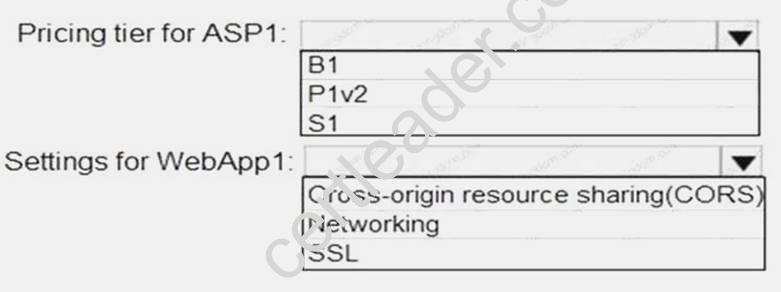
Answer:
Explanation: Box 1: B1
B1 (Basic) would minimize cost compared P1v2 (premium) and S1 (standard). Box 2: Cross Origin Resource Sharing (CORS)
Once you set the CORS rules for the service, then a properly authenticated request made against the service from a different domain will be evaluated to determine whether it is allowed according to the rules you have specified.
Note: CORS (Cross Origin Resource Sharing) is an HTTP feature that enables a web application running under one domain to access resources in another domain. In order to reduce the possibility of cross-site scripting attacks, all modern web browsers implement a security restriction known as
same-origin policy. This prevents a web page from calling APIs in a different domain. CORS provides a secure way to allow one origin (the origin domain) to call APIs in another origin.
References:
https://azure.microsoft.com/en-us/pricing/details/app-service/windows/ https://docs.microsoft.com/en-us/azure/cdn/cdn-cors
NEW QUESTION 9
You are configuring serverless computing in Azure.
You need to receive an email message whenever a resource is created in or deleted from a resource group. Which three actions should you perform in sequence? To answer, move the appropriate actions from the list of actions to the answer area and arrange them in the correct order.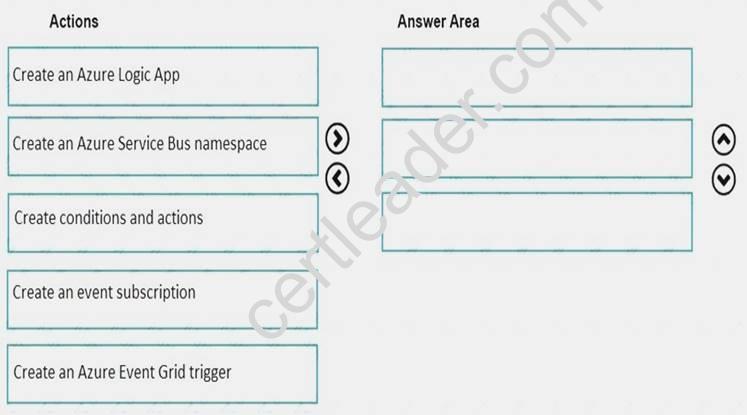
Answer:
Explanation: Step 1: Create an event subscription
When you subscribe to events for a resource group, your endpoint receives all events for that resource group. Step 2: Create an Azure Event Grid trigger
Step 3: Create conditions and actions References:
https://docs.microsoft.com/en-us/azure/event-grid/event-schema-resource-groups
NEW QUESTION 10
HOT SPOT
You need to provision the resources in Azure to support the virtual machine that will be migrated from the New York office.
What should you include in the solution? To answer, select the appropriate options in the answer
area.
NOTE: Each correct selection is worth one point.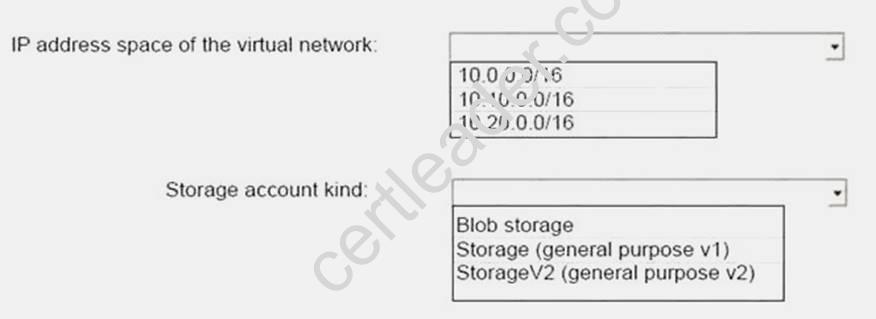
Answer:
Explanation: 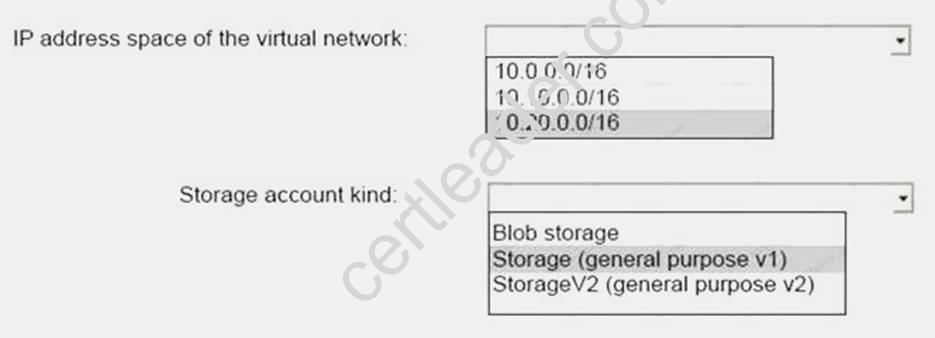
Box 1: 10.20.0.0/16
Scenario: The New York office an IP address of 10.0.0.0/16. The Los Angeles office uses an IP address space of 10.10.0.0/16.
Box 2: Storage (general purpose v1)
Scenario: The New York office has a virtual machine named VM1 that has the vSphere console installed.
NEW QUESTION 11
You configure Azure AD Connect for Azure Active Directory Seamless Single Sign-On (Azure AD Seamless SSO) for an on-premises network. Users report that when they attempt to access myapps.microsoft.com, they are prompted multiple times to sign in and are forced to use an account name that ends with onmicrosoft.com.
You discover that there is a UPN mismatch between Azure AD and the on-premises Active Directory. You need to ensure that the users can use single-sign on (SSO) to access Azure resources.
What should you do first?
- A. From the on-premises network, deploy Active Directory Federation Services (AD FS).
- B. From Azure AD, add and verify a custom domain name.
- C. From the on-premises network, request a new certificate that contains the Active Directory domain name.
- D. From the server that runs Azure AD Connect, modify the filtering option
Answer: B
Explanation: Azure AD Connect lists the UPN suffixes that are defined for the domains and tries to match them
with a custom domain in Azure AD. Then it helps you with the appropriate action that needs to be taken. The Azure AD sign-in page lists the UPN suffixes that are defined for on-premises Active Directory and displays the corresponding status against each suffix. The status values can be one of the following:
State: Verified Azure AD Connect found a matching verified domain in Azure AD. All users for this domain can sign in by using their on-premises credentials.
State: Not verified Azure AD Connect found a matching custom domain in Azure AD, but it isn't verified. The UPN suffix of the users of this domain will be changed to the default .onmicrosoft.com suffix after synchronization if the domain isn't verified.
Action Required: Verify the custom domain in Azure AD.
References: https://docs.microsoft.com/en-us/azure/active-directory/hybrid/plan-connect-userQuestions& Answers PDF P-80 signin
NEW QUESTION 12
You need to deploy an Azure load balancer named Ib 1015 to your Azure subscription. The solution must meet the following requirements:
-Support the load balancing of IP traffic from the Internet to Azure virtual machines connected to VNET1016 subnet0.
-Prov.de 4 Service level Agreement (SWJ of 99.99 percent ability for the Azure virtual machines.
-Minimize Azure-related costs.
What should you do from the Azure portal?
To complete this task, you do NOT need to wait for the deployment to complete. Once the deployment start in Azure, you can move to the next task.
Answer:
Explanation: Step 1:
On the top left-hand side of the screen, click Create a resource > Networking > Load Balancer. Step 2:
In the Create a load balancer page enter these values for the load balancer: myLoadBalancer - for the name of the load balancer.
Internal - for the type of the load balancer. Basic - for SKU version.
Microsoft guarantees that apps running in a customer subscription will be available 99.99% of the time.
VNET1016subnet0 - for subnet that you choose from the list of existing subnets.
Step 3: Accept the default values for the other settings and click Create to create the load balancer.
NEW QUESTION 13
Your marketing team creates a new website that you must load balance for 99.99 percent availability. You need to deploy and configure a solution for both machines in the Web-AS availability set to load balance the website over HTTP. The solution must use the load balancer your resource group.
What should you do from the Azure portal?
Answer:
Explanation: To distribute traffic to the VMs in the availability set, a back-end address pool contains the IP addresses of the virtual NICs that are connected to the load balancer. Create the back-end address pool to include the VMs in the availability set.
Step 1:
Select All resources on the left menu, and then select LoadBalancer from the resource list. Step 2:
Under Settings, select Backend pools, and then select Add. Step 3:
On the Add a backend pool page, select the Web-AS availability set, and then select OK: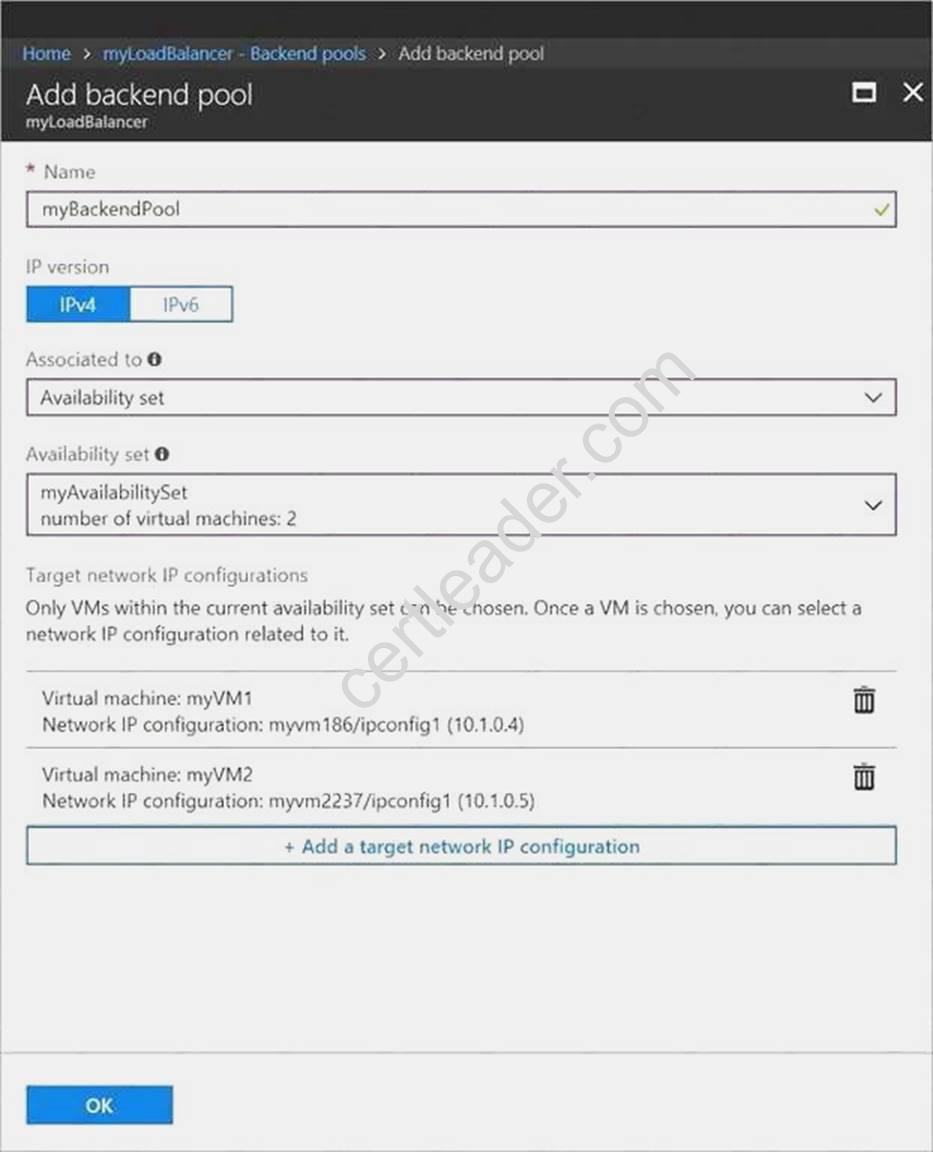
References:
https://docs.microsoft.com/en-us/azure/load-balancer/quickstart-create-basic-load-balancer-portal
NEW QUESTION 14
You have the Azure virtual machines shown in the following table.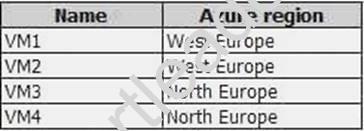
You have a Recovery Services vault that protects VM1 and VM2. You need to protect VM3 and VM4 by using Recovery Services. What should you do first?
- A. Configure the extensions for VM3 and VM4.
- B. Create a new Recovery Services vault.
- C. Create a storage account.
- D. Create a new backup polic
Answer: B
Explanation: A Recovery Services vault is a storage entity in Azure that houses dat
A. The data is typically copies of
data, or configuration information for virtual machines (VMs), workloads, servers, or workstations. You can use Recovery Services vaults to hold backup data for various Azure services
References: https://docs.microsoft.com/en-us/azure/site-recovery/azure-to-azure-tutorial-enablereplication
NEW QUESTION 15
You have an azure subscription that contain a virtual named VNet1. VNet1. contains four subnets named Gatesway, perimeter, NVA, and production.
The NVA contain two network virtual appliance (NVAs) that will network traffic inspection between the perimeter subnet and the production subnet.
You need o implement an Azure load balancer for the NVAs. The solution must meet the following requirements:
The NVAs must run in an active-active configuration that uses automatic failover.
The NVA must load balance traffic to two services on the Production subnet. The services have different IP addresses
Which three actions should you perform? Each correct answer presents parts of the solution. NOTE: Each correct selection is worth one point.
- A. Add two load balancing rules that have HA Ports enabled and Floating IP disabled.
- B. Deploy a standard load balancer.
- C. Add a frontend IP configuration, two backend pools, and a health prob.
- D. Add a frontend IP configuration, a backend pool, and a health probe.
- E. Add two load balancing rules that have HA Ports and Floating IP enabled.
- F. Deploy a basic load balance
Answer: BCE
Explanation: A standard load balancer is required for the HA ports.
-Two backend pools are needed as there are two services with different IP addresses.
-Floating IP rule is used where backend ports are reused. Incorrect Answers:
F: HA Ports are not available for the basic load balancer. References:
https://docs.microsoft.com/en-us/azure/load-balancer/load-balancer-standard-overview https://docs.microsoft.com/en-us/azure/load-balancer/load-balancer-multivip-overview
NEW QUESTION 16
Your Azure environment contains an application gateway and custom apps.
Another administrator modifies the application gateway and the apps to use HTTP over TCP port 8080.
Users report that they can no longer connect to the apps.
You suspect that the cause of the issue is a change in the configuration of the application gateway. You need to modify the application gateway to resolve the issue.
What should you do from the Azure portal?
Answer:
Explanation: Step 1:
Select Networking and then select Application Gateway in the Featured list, and select the application gateway, and select the settings.
Step 2:
Click HTTP for the protocol of the listener and make sure that the port is defined as 443.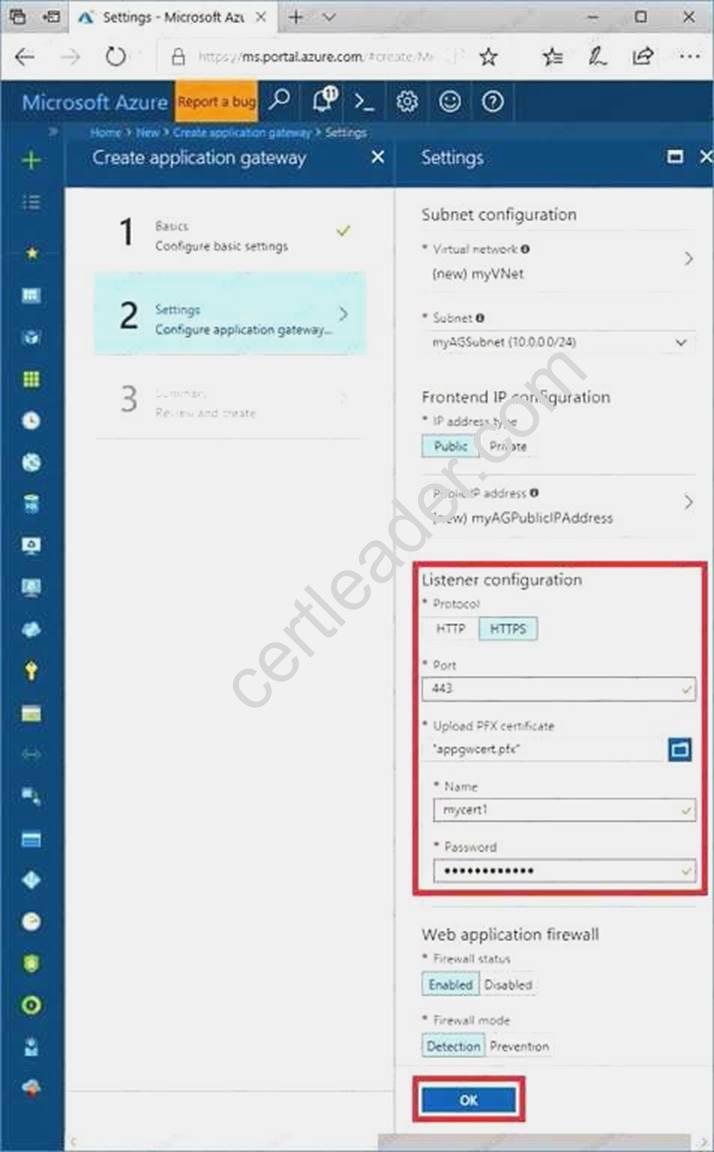
References:
https://docs.microsoft.com/en-us/azure/application-gateway/create-ssl-portal
NEW QUESTION 17
SIMULATION
Click to expand each objective. To connect to the Azure portal, type https://portal.azure.com in the browser address bar.

When you are finished performing all the tasks, click the ‘Next’ button.
Note that you cannot return to the lab once you click the ‘Next’ button. Scoring occur in the background while you complete the rest of the exam.
Overview
The following section of the exam is a lab. In this section, you will perform a set of tasks in a live environment. While most functionality will be available to you as it would be in a live environment, some functionality (e.g., copy and paste, ability to navigate to external websites) will not be possible by design. Scoring is based on the outcome of performing the tasks stated in the lab. In other words, it doesn’t matter how you accomplish the task, if you successfully perform it, you will earn credit for that task.
Labs are not timed separately, and this exam may have more than one lab that you must complete. You can use as much time as you would like to complete each lab. But, you should manage your time appropriately to ensure that you are able to complete the lab(s) and all other sections of the exam in the time provided.
Please note that once you submit your work by clicking the Next button within a lab, you will NOT be able to return to the lab.
To start the lab
You may start the lab by clicking the Next button.
You need to allow RDP connections over TCP port 3389 to VM1 from the internet. The solution must prevent connections from the Internet over all other TCP ports.
What should you do from the Azure portal?
Answer:
Explanation: Step 1: Create a new network security group Step 2: Select your new network security group.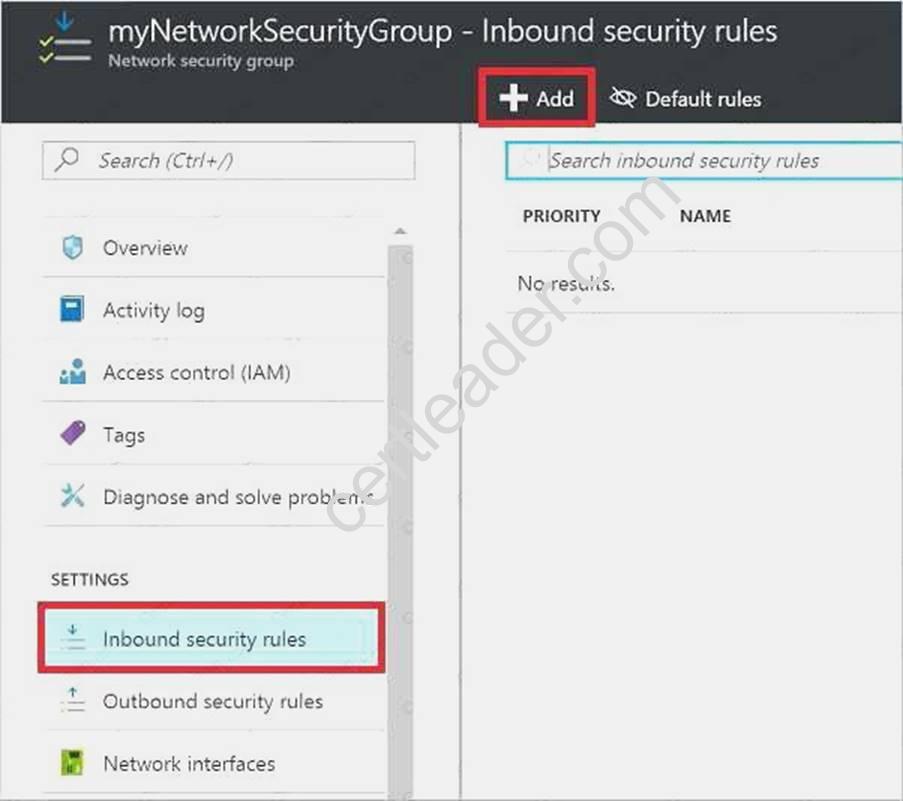
Step 3: Select Inbound security rules, . Under Add inbound security rule, enter the following Destination: Select Network security group, and then select the security group you created previously.
Destination port ranges: 3389 Protocol: Select TCP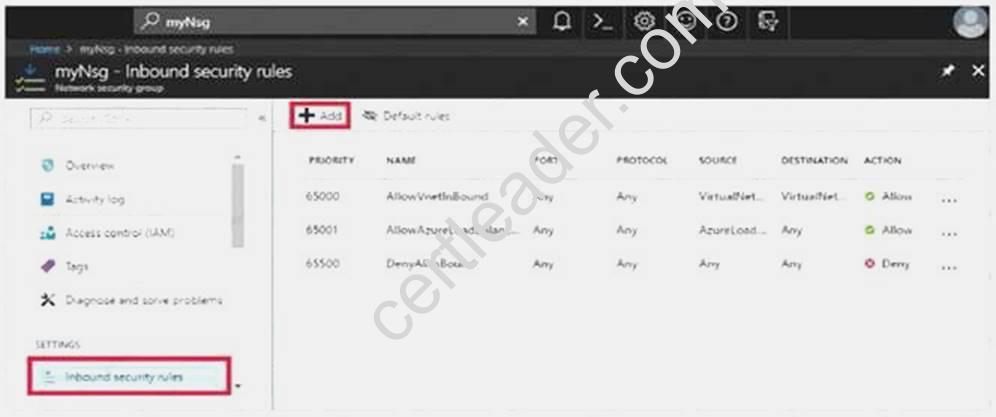
References: https://docs.microsoft.com/en-us/azure/virtual-network/tutorial-filter-network-traffic
NEW QUESTION 18
You have an Azure Active Directory (Azure AD) tenant.
All administrators must enter a verification code to access the Azure portal.
You need to ensure that the administrators can access the Azure portal only from your on-premises network. What should you configure?
- A. the multi-factor authentication service settings
- B. an Azure AD Identity Protection user risk policy
- C. the default for all the roles in Azure AD Privileged Identity Management
- D. an Azure AD Identity Protection sign-in risk policy
Answer: A
P.S. Easily pass AZ-102 Exam with 195 Q&As Certleader Dumps & pdf Version, Welcome to Download the Newest Certleader AZ-102 Dumps: https://www.certleader.com/AZ-102-dumps.html (195 New Questions)