Your success in Oracle 1z0-931-20 is our sole target and we develop all our 1z0-931-20 braindumps in a way that facilitates the attainment of this target. Not only is our 1z0-931-20 study material the best you can find, it is also the most detailed and the most updated. 1z0-931-20 Practice Exams for Oracle 1z0-931-20 are written to the highest standards of technical accuracy.
Free 1z0-931-20 Demo Online For Oracle Certifitcation:
NEW QUESTION 1
Which two are correct actions to take in order to Download the Autonomous Database Credentials?
- A. Click on the Autonomous Data Warehouse in the menu, click a database name, then Choose DB Connection button, then Download the Wallet.
- B. Click on the Autonomous Data Warehouse section, pick a database, then Choose Actions, then Download the Wallet.
- C. Click the Compute section of the menu, then choose Instance Configurations, then Download Wallet.
- D. Click on the Object Storage and find your Autonomous Bucket and Download the Wallet Credentials.
- E. Find the Service Console for your Autonomous Database, then pick Administration, then Download the Client Credentials (Wallet).
Answer: AE
NEW QUESTION 2
Which two options are available to restore an Autonomous Data Warehouse? (Choose two.)
- A. Backup and recovery must be done using Recovery Manager(RMAN).
- B. Select the snapshot of the backup.
- C. Select the archived redo logs.
- D. Select the backup from which restore needs to be done.
- E. Specify the point in time (timestamp) to restore.
Answer: DE
Explanation:
In the Restore prompt, select Specify Timestamp or Select Backup to restore to a point in time or to restore
from a specified backup.
https://docs.oracle.com/en/cloud/paas/autonomous-data-warehouse-cloud/user/backkup-recover.html#GUID-78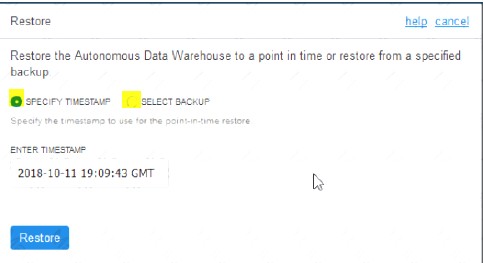
NEW QUESTION 3
Which three security features are available in Oracle Autonomous Database Shared Infrastructure?
- A. Transparent Data Encryption
- B. Database Vault
- C. Customer Managed Keys
- D. Data Redaction
- E. Audit Vault
Answer: ABC
Explanation:
https://docs.oracle.com/en/cloud/paas/atp-cloud/atpfg/security-features-adb1.html#GUID-89E3C22E-D4EB-472
NEW QUESTION 4
Which method will NOT permit you to change the database Admin Password of a Autonomous Database on Shared Infrastructure?
- A. Admin page of the Cloud Service Console
- B. OCI CLI
- C. OS command line from the database server.
- D. SQLDeveloper
Answer: B
NEW QUESTION 5
Which three event types are supported for Autonomous Database?
- A. Terminate End
- B. Maintenance Begin
- C. Change Compartment Begin
- D. Change Autoscaling Configuration Compartment
- E. Update IORM Begin
Answer: ABC
Explanation:
https://docs.oracle.com/en-us/iaas/Content/Events/Reference/eventsproducers.htm
NEW QUESTION 6
The Oracle Autonomous Database dedicated Exadata infrastructure feature is based upon which Oracle Cloud resources?
- A. Oracle Machine Learning Zeppelin Notebook, Autonomous Exadata Infrastructure, Fleet Administrator, Database Administrator,
- B. Virtual Cloud Network, Compartments, Policies, Autonomous Exadata Infrastructure
- C. Autonomous Exadata Infrastructure, Autonomous Backup, Autonomous Container Database, Autonomous Database
- D. Fleet Administrator, Database Administrator, Database User, Autonomous Exadata Infrastructure
Answer: A
NEW QUESTION 7
Which two statements are true when running DBMS_CLOUD.COPY_DATA? (Choose two.)
- A. The source file can be in either Oracle Standard Storage or Oracle Archive Storage bucket in the Object Store.
- B. The source files can reside in Oracle Object Storage, Amazon S3 Object storage, or Azure Blob storage.
- C. A valid credential must be created prior to running the DBMS_CLOUD.COPY_DATA procedure.
- D. The source file will be automatically removed after the DBMS_CLOUD.COPY_DATA procedure finishes successfully.
- E. The target table will be created in Autonomous Database if it does not already exist.
Answer: BC
Explanation:
https://docs.oracle.com/en/cloud/paas/autonomous-data-warehouse-cloud/user/file-uri-formats.html#GUID-5D3 https://docs.oracle.com/en/cloud/paas/autonomous-data-warehouse-cloud/user/dbms-cloud.html#GUID-9428EA
NEW QUESTION 8
Which statement is NOT correct when using Automatic Indexing on Autonomous Data Warehouse?
- A. Process includes identify candidates, create invisible auto indexes , verify with implement if performance improved and delete unused.
- B. You can use the dbms_auto_index package to report on the automatic task and to set your preferences.
- C. It is enabled by default.
- D. You can control behavior at the statement level using the use_aoto_indexes or NO_USE_AUTO_INDEXES hints.
- E. The indexing feature is implemented as an automatic task that runs at a fixed interval.
Answer: E
NEW QUESTION 9
Where can a user's public ssh key be added on the Oracle Cloud Infrastructure Console in order to execute API calls?
- A. On the Autonomous Database Console.
- B. SSH keys are not required in Oracle Cloud Infrastructure.
- C. SSH keys cannot be added from consol
- D. They have to be added using REST APIs only.
- E. Navigate to Identity, select Users panel on the console and select "Add Public Key".
Answer: D
Explanation:
- In the Console, click Identity, and then click Users. Locate the user in the list, and then click the user's name to view the details.
-Click Add Public Key.
- Paste the key's value into the window and click Add.
NEW QUESTION 10
What are two differentiators of Oracle Autonomous Database Dedicated Infrastructure?
- A. Users have OS access to the database machine.
- B. Users can customize the maintenance schedule.
- C. It offers greater control and isolation starting at the Exadata cloud infrastructure level.
- D. Users have SYS privileges in the database.
- E. Users can customize the OS stack and add additional packages
Answer: CD
NEW QUESTION 11
While Autonomous Transaction Processing and Autonomous Data Warehouse use the same Oracle database, which statement is true about the workloads?
- A. Autonomous Transaction Processing memory usage optimizes workloads for parallel joins and aggregations.
- B. Autonomous Data Warehouse workloads are optimized for mixed workloads.
- C. Autonomous Transaction Processing workloads are optimized for data warehouse, data mart, and data lake.
- D. Data that is bulk loaded, by default, uses the row format in Autonomous Transaction Processing where Autonomous Data Warehouse data format is columnar.
Answer: D
Explanation:
- Both ADW and ATP share the Autonomous Database platform of Oracle Database on Exadata Cloud infrastructure.
The difference is how the services have been optimized within the database. When you start loading data into the autonomous database, we store the data in the appropriate format for the workload.
* If it is ADW, then we store data in columnar format because that's the best format for analytics processing.
• If it is ATP, then we store the data in row format because that's the best format for fast single row lookups.
- Oracle Autonomous Database is offered in two workload-optimized flavors
* Autonomous Data Warehouse (ADW), which has been optimized for analytic workloads
• Autonomous Transaction Processing (ATP). ATP is optimized for transaction processing or mixed workload https://docs.oracle.com/en/cloud/paas/atp-cloud/atpug/autonomous-intro-atp.html#GUID-B90147B2-EA04-414 https://docs.oracle.com/en/cloud/paas/atp-cloud/atpug/autonomous-intro-atp.html#GUID-B90147B2-EA04-414
NEW QUESTION 12
Which statement is true about connecting an OCI compute instance to a Shared Autonomous Database?
- A. The Autonomous Database must be in the same VCN and Subnet as the Compute instance.
- B. The OCI compute instance does not support connecting to a Shared Autonomous Database.
- C. The Autonomous Database must belong to a Network Security Group (NSG).
- D. The OCI compute instance can be used with an Always-Free Autonomous Database account.
- E. A Private Endpoint is required to connect to the Shared-Autonomous Database.
Answer: A
NEW QUESTION 13
Which three statements are true about procedures in the DBMS_CLOUD package? (Choose three.)
- A. The DBMS_CLOUD.PUT_OBJECT procedure copies a file from Cloud Object Storage to the Autonomous Data Warehouse.
- B. The DBMS_CLOUD.CREATE_CREDENTIAL procedure stores Cloud Object Storage credentials in the Autonomous Data Warehouse database.
- C. The DBMS_CLOUD.VALIDATE_EXTERNAL_TABLE procedure validates the source files for an external table, generates log information, and stores the rows that do not match the format options specified for the external table in a badfile table on Autonomous Data Warehouse.
- D. The DBMS_CLOUD.DELETE_FILE procedure removes the credentials file from the Autonomous Data Warehouse database.
- E. The DBMS_CLOUD.CREATE_EXTERNAL_TABLE procedure creates an external table on files in the clou
- F. You can run queries on external data from the Autonomous Data Warehouse.
Answer: BCE
Explanation:
DELETE_FILE Procedure
This procedure removes the specified file from the specified directory on Autonomous Data Warehouse. CREATE_CREDENTIAL Procedure
This procedure stores Cloud Object Storage credentials in the Autonomous Data Warehouse database. Use stored credentials for data loading or for querying external data residing in the Cloud.
PUTJDBJECT Procedure
This procedure copies a file from Autonomous Data Warehouse to the Cloud Object Storage. The maximum file size allowed in this procedure is 5 gigabytes (GB).
VALIDATE EXTERNAL TABLE Procedure
This procedure validates the source files for an external table, generates log information, and stores the rows that do not match the format options specified for the external table in a badfile table on Autonomous Data Warehouse.
CREATE_EXTERNAL_TABLE Procedure
This procedure creates an external table on files in the Cloud. This allows you to run queries on external data from Autonomous Data Warehouse.
To use Data Pump from ADB, a credential identifying the Object Storage bucket to use must be defined with a DBMS_CLOUD.CREATE_CREDENTIAL function. This will allow ADB to access objects that are stored in the object store , including dump files. To export an existing database to prepare for import into ADB, use the XTP command and add the ex elude option for database functionality that is not recommended or supported in ADB. This will prevent errors during the imp oil process.
This process is not automatic. And if the logs are not moved, you will receive a warning when running the MDB that the logs are not there. In this example, we're
moving the log import.log to object store with a DBMS_CLOUD.PUT_OBJECT command.
VALIDATE_EXTERNAL_TABLE Procedure
This procedure validates the source files for an external table, generates log information, and stores the rows that do not match the format options specified for the external table in a badfile table on Autonomous Database. The overloaded form enables you to use the operation_id parameter.
PUT_OBJECT Procedure
This procedure copies a file from Autonomous Database to the Cloud Object Storage. The maximum file size allowed in this procedure is 5 gigabytes (GB)
DELETE FILE Procedure
This procedure removes the specified file from the specified directory on Autonomous Database.
CREATE_EXTERNAL_TABLE Procedure
This procedure creates an external table on files in the Cloud. This allows you to run queries on external data from Autonomous Database.
NEW QUESTION 14
What REST verb is used to create an Autonomous Database service using REST APIs?
- A. An "INSERT" REST call
- B. A "GET" REST call
- C. A "POST" REST call
- D. A "PUT" REST call
Answer: C
Explanation:
https://docs.oracle.com/en/cloud/paas/integration-cloud/rest-api/SendRequests.html
NEW QUESTION 15
Which statement is correct about managing and monitoring of Autonomous Database?
- A. You can use Service console to move Autonomous DB between compartments.
- B. You can use Service console to create manual backups of Autonomous database.
- C. You can use Service console to enable or disable auto scaling of Autonomous DB.
- D. You can use Service console to manage runaway SQL statements on Autonomous DB.
Answer: A
NEW QUESTION 16
Which statement is true when the Autonomous Database has auto scaling enabled?
- A. Database concurrency is scaled up when needed by the workload.
- B. Increases the number of sessions available to the database.
- C. Scales the PGA and SGA size when needed for the workload.
- D. Enables the database to use up to 3x CPU/IO resources immediately when needed by the workload.
Answer: D
NEW QUESTION 17
Which statement is FALSE about Autonomous Database Maintenance on dedicated Exadata infrastructure?
- A. If a scheduled container database maintenance run cannot take place, Oracle will automatically reschedule the container database maintenance for the following quarter.
- B. Autonomous Exadata Infrastructure maintenance takes place at least once each quarter and is mandatory.
- C. You can change your container database maintenance window or reschedule a single container database maintenance run to ensure that your container database maintenance runs follow infrastructure maintenance within the same quarter.
- D. Autonomous Exadata Infrastructure maintenance runs are for infrastructure patching (including patching of the Exadata grid infrastructure code and operating systems updates), and include database patching.
Answer: D
NEW QUESTION 18
You are the admin user of an Autonomous Database (ADB) instance. A new business analyst has joined the team and would like to explore ADB tables using SQL Developer Web.
What steps do you need to take?
- A. Create a database user (with connect, resource, object privileges), enable the schema to use SQL Developer and provide the user with the user-specific modified URL.
- B. Create a database user with the default privileges.
- C. Create a database user with connect, resource, and object privileges.
- D. Create an IDCS use
- E. Create a database user with connect, resource, and object privileges.
Answer: A
NEW QUESTION 19
How do you change the tablespace quota for a user on Autonomous Database on Shared Infrastructure?
- A. Execute alter database for user MTHEO tablespace DATA quota = 10G;
- B. Execute alter user MTHEO quota unlimited on tablespace DATA;
- C. Execute DBMS_CLOUD_ADMI
- D. GRANT_TABLESPACE_QOOTA (username => 'MTHEO' ,Tablespace___quota => "UNLIMITED*);
- E. Execute alter tablespace DATA set quota = 10G;
Answer: D
NEW QUESTION 20
How can an Autonomous Database resource be provisioned without logging into the Oracle Cloud Infrastructure console?
- A. It cannot be done.
- B. Using Database Configuration Assistant (DBCA) on the database server.
- C. Using the Oracle Cloud Infrastructure Command Line interface tool or REST API calls.
- D. Connecting to the Cloud Infrastructure Command console via SSH wallet.
Answer: C
Explanation:
The CLI is a small footprint tool that you can use on its own or with the Console to complete Oracle Cloud Infrastructure tasks. The CLI provides the same core functionality as the Console, plus additional commands.
https://blogs.oracle.com/datawarehousing/managing-autonomous-data-warehouse-using-oci-curl Examples of using Autonomous Database managing by REST API
https://oracle.github.io/learning-library/workshops/autonomous-transaction-processing/LabGuide900ConfigureO
NEW QUESTION 21
During the provisioning of an Autonomous Database on Dedicated hardware, what does the Database Administrator need to select to determine where the Autonomous Database is created on the Dedicated infrastructure?
- A. the name or OCID of the Exadata infrastructure which was assigned by the the Fleet Administrator
- B. the Client Credentials wallet which is used to connect to the Autonomous Database
- C. the 'High Availability Container Database' in which the Autonomous instance should run
- D. the Compartment of the Dedicated infrastructure as each compartment only runs 1 Dedicated environment
- E. the Listener endpoint where the Autonomous Database should register on
Answer: B
NEW QUESTION 22
Which two statements are correct about Autonomous Data Warehouse on Shared Exadata Infrastructure?
- A. Parallelism is not enabled by default.
- B. Compression is enabled by defaul
- C. Autonomous Data Warehouse uses Hybrid Columnar Compression for all tables by default.
- D. Oracle Database Result Cache is enabled by default for all SQL statements.
- E. You have direct access to the database node.
Answer: AB
NEW QUESTION 23
......
Thanks for reading the newest 1z0-931-20 exam dumps! We recommend you to try the PREMIUM 2passeasy 1z0-931-20 dumps in VCE and PDF here: https://www.2passeasy.com/dumps/1z0-931-20/ (60 Q&As Dumps)