Our pass rate is high to 98.9% and the similarity percentage between our N10-008 study guide and real exam is 90% based on our seven-year educating experience. Do you want achievements in the CompTIA N10-008 exam in just one try? I am currently studying for the CompTIA N10-008 exam. Latest CompTIA N10-008 Test exam practice questions and answers, Try CompTIA N10-008 Brain Dumps First.
Free demo questions for CompTIA N10-008 Exam Dumps Below:
NEW QUESTION 1
Which of the following is a document that states what the minimum performance expectations are within a network?
- A. Memorandum of understanding
- B. Service-level agreement
- C. Non-disclosure agreement
- D. Baseline metrics
Answer: B
Explanation:
A service-level agreement (SLA) is a document that states what the minimum performance expectations are within a network, such as uptime, throughput, latency, and security. An SLA is usually signed between a service provider and a customer, and it specifies the penalties or remedies if the service level is not met
NEW QUESTION 2
A technician manages a DHCP scope but needs to allocate a portion of the scope’s subnet for statically assigned devices. Which of the following DHCP concepts would be BEST to use to prevent IP address conflicts?
- A. Dynamic assignment
- B. Exclusion range
- C. Address reservation
- D. IP helper
Answer: B
Explanation:
To prevent IP address conflicts when allocating a portion of a DHCP scope's subnet for statically assigned devices, it is recommended to use the concept of DHCP exclusion ranges. DHCP exclusion ranges allow a DHCP administrator to specify a range of IP addresses within the scope that should not be assigned to DHCP clients. This can be useful in situations where some devices on the network need to be assigned static IP addresses, as it ensures that the statically assigned addresses do not overlap with addresses assigned by the DHCP server. To set up a DHCP exclusion range, the administrator needs to specify the start and end IP addresses of the range, as well as the subnet mask. The DHCP server will then exclude the specified range of addresses from its pool of available addresses, and will not assign them to DHCP clients. By using DHCP exclusion ranges, the technician can ensure that the statically assigned addresses do not conflict with addresses assigned by the DHCP server, and can prevent IP address conflicts on the network.
Anthony Sequeira
"Another frequent configuration you might make in a DHCP implementation is to configure an exclusion range. This is a portion of the address pool that you never want leased out to clients in the network. Perhaps you have numbered your servers 192.168.1.1–192.168.1.10. Because the servers are statically configured with these addresses, you exclude these addresses from the 192.168.1.0/24 pool of addresses."
Mike Meyers
"Exclusion ranges represent an IP address or range of IP addresses from the pool of addresses that are not to be given out by the DHCP server. Exclusions should be made for the static addresses manually configured on servers and router interfaces, so these IP addresses won’t be offered to DHCP clients."
NEW QUESTION 3
Which of the following types of data center architectures will MOST likely be used in a large SDN and can be extended beyond the data center?
- A. iSCSI
- B. FCoE
- C. Three-tiered network
- D. Spine and leaf
- E. Top-of-rack switching
Answer: D
Explanation:
The type of data center architecture that will most likely be used in a large SDN and can be extended beyond the data center is spine and leaf. Spine and leaf is a network topology that consists of two layers of switches: spine switches and leaf switches. Spine switches are interconnected to each other and form the core of the network, while leaf switches are connected to each spine switch and form the access layer of the network. Spine and leaf topology provides high scalability, performance, and flexibility for data center networks, especially for SDN (Software Defined Networking) environments that require dynamic traffic flows and virtualization. References: CompTIA Network+ N10-008 Certification Study Guide, page 16; The Official CompTIA Network+ Student Guide (Exam N10-008), page 1-9.
NEW QUESTION 4
A company is reviewing ways to cut the overall cost of Its IT budget. A network technician suggests removing various computer programs from the IT budget and only providing these
programs on an as-needed basis. Which of the following models would meet this requirement?
- A. Multitinency
- B. laaS
- C. SaaS
- D. VPN
Answer: C
Explanation:
SaaS stands for Software as a Service and is a cloud computing model where software applications are hosted and delivered over the internet by a service provider. SaaS can help the company cut the overall cost of its IT budget by eliminating the need to purchase, install, update, and maintain various computer programs on its own devices. The company can access the programs on an as-needed basis and pay only for what it uses. Multitenancy is a feature of cloud computing where multiple customers share the same physical or virtual resources. IaaS stands for Infrastructure as a Service and is a cloud computing model where computing resources such as servers, storage, and networking are provided over the internet by a service provider. VPN stands for Virtual Private Network and is a technology that creates a secure and encrypted connection over a public network.
References: CompTIA Network+ Certification Exam Objectives Version 7.0 (N10-007), Objective 1.9: Compare and contrast common network service types.
NEW QUESTION 5
A network technician is troubleshooting an issue that involves connecting to a server via SSH. The server has one network interface that does not support subinterfaces. The technician
runs a command on the server and receives the following output:
On the host, the technician runs another command and receives the following:
Which of the following best explains the issue?
- A. A firewall is blocking access to the server.
- B. The server is plugged into a trunk port.
- C. The host does not have a route to the server.
- D. The server is not running the SSH daemon.
Answer: C
NEW QUESTION 6
A technician is troubleshooting a client's report about poor wireless performance. Using a client monitor, the technician notes the following information: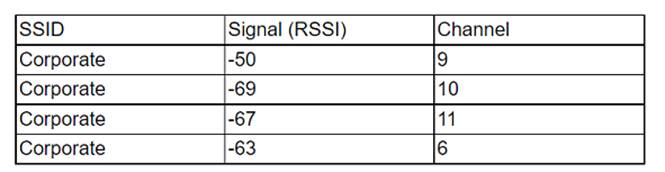
Which of the following is most likely the cause of the issue?
- A. Channel overlap
- B. Poor signal
- C. Incorrect power settings
- D. Wrong antenna type
Answer: A
Explanation:
Channel overlap is a situation where multiple wireless networks use the same or adjacent frequency channels, causing interference and degradation of performance. According to the image, the corporate SSID is using channels 9, 10, 11, and 6, which are overlapping with each other and with other networks in the area. This can reduce the signal quality and strength, increase the noise and latency, and cause dropouts and connectivity issues. To avoid channel overlap, it is recommended to use non-overlapping channels, such as 1, 6, and 11, in the 2.4 GHz band, or to switch to the 5 GHz band if possible12.
References
1 - What happens when wifi channels overlap? - Server Fault
2 - Is it better to use a crowded 2.4GHz Wi-Fi channel 1, 6, 11 or “unused” 3, 4, 8, or 9? - Super User
NEW QUESTION 7
A user wants to avoid using a password to access a third-party website. Which of the following does the user need in order to allow this type of access to the third-party website?
- A. Multifactor
- B. RADIUS
- C. SSO
- D. Local authentication
Answer: C
NEW QUESTION 8
Users are reporting intermittent Wi-Fi connectivity in specific parts of a building. Which of the following should the network administrator check FIRST when troubleshooting this issue? (Select TWO).
- A. Site survey
- B. EIRP
- C. AP placement
- D. Captive portal
- E. SSID assignment
- F. AP association time
Answer: AC
Explanation:
This is a coverage issue. WAP placement and power need to be checked. Site survey should be done NEXT because it takes a while.
NEW QUESTION 9
An on-call network technician receives an automated email alert stating that a power supply on a firewall has just powered down. Which of the following protocols would best allow for this level of detailed device monitoring?
- A. TFTP
- B. TLS
- C. SSL
- D. SNMP
Answer: D
Explanation:
SNMP stands for Simple Network Management Protocol, and it is a protocol that allows network devices to communicate their status, performance, and configuration information to a central management system. SNMP can be used to monitor and manage various aspects of network devices, such as CPU usage, memory utilization, interface statistics, temperature, voltage, power supply, etc. SNMP can also generate alerts or notifications when certain events or thresholds are reached, such as a power supply failure, a link down, or a high traffic volume. SNMP is widely used for network monitoring and troubleshooting purposes, as it provides a comprehensive and detailed view of the network health and performance.
The other options are not correct because they are not protocols that allow for detailed device monitoring. They are:
✑ TFTP. TFTP stands for Trivial File Transfer Protocol, and it is a protocol that allows for simple and fast file transfer between network devices. TFTP is often used to transfer configuration files, firmware updates, or boot images to network devices, such as routers, switches, or firewalls. TFTP does not provide any monitoring or management capabilities for network devices, nor does it generate any alerts or notifications.
✑ TLS. TLS stands for Transport Layer Security, and it is a protocol that provides encryption and authentication for data transmission over a network. TLS is often used to secure web traffic, email, or other applications that use TCP as the transport protocol. TLS does not provide any monitoring or management capabilities for network devices, nor does it generate any alerts or notifications.
✑ SSL. SSL stands for Secure Sockets Layer, and it is a protocol that provides encryption and authentication for data transmission over a network. SSL is the predecessor of TLS, and it is still used to secure some web traffic, email, or other applications that use TCP as the transport protocol. SSL does not provide any monitoring or management capabilities for network devices, nor does it generate any alerts or notifications.
References1: What is SNMP? - Definition from WhatIs.com2: Network+ (Plus) Certification
| CompTIA IT Certifications3: What is TFTP? - Definition from WhatIs.com4: What is TLS? - Definition from WhatIs.com5: What is SSL? - Definition from WhatIs.com
NEW QUESTION 10
A network technician is configuring a new firewall for a company with the necessary access requirements to be allowed through the firewall. Which of the following would normally be applied as the LAST rule in the firewall?
- A. Secure SNMP
- B. Port security
- C. Implicit deny
- D. DHCP snooping
Answer: C
Explanation:
Implicit deny is a firewall rule that blocks all traffic that is not explicitly allowed by other rules. Implicit deny is usually applied as the last rule in the firewall to ensure that only the necessary access requirements are allowed through the firewall and that any unwanted or malicious traffic is rejected. Implicit deny can also provide a default security policy and a baseline for auditing and logging purposes.
Secure SNMP is a protocol that allows network devices to send event messages to a centralized server or console for logging and analysis. Secure SNMP can be used to monitor and manage the status, performance, and configuration of network devices. Secure SNMP can also help to detect and respond to potential problems or faults on the network. However, secure SNMP is not a firewall rule; it is a network management protocol.
Port security is a feature that allows a switch to restrict the devices that can connect to a specific port based on their MAC addresses. Port security can help to prevent unauthorized access, spoofing, or MAC flooding attacks on the switch. However, port security is not a firewall rule; it is a switch feature.
DHCP snooping is a feature that allows a switch to filter DHCP messages and prevent rogue DHCP servers from assigning IP addresses to devices on the network. DHCP snooping can help to prevent IP address conflicts, spoofing, or denial-of-service attacks on the network. However, DHCP snooping is not a firewall rule; it is a switch feature.
NEW QUESTION 11
A company is designing a SAN and would like to use STP as its medium for communication. Which of the following protocols would BEST suit me company's needs?
- A. SFTP
- B. Fibre Channel
- C. iSCSI
- D. FTP
Answer: B
Explanation:
A SAN also employs a series of protocols enabling software to communicate or prepare data for storage. The most common protocol is the Fibre Channel Protocol (FCP), which maps SCSI commands over FC technology. The iSCSI SANs will employ an iSCSI protocol that maps SCSI commands over TCP/IP.
STP (Spanning Tree Protocol) is a protocol used to prevent loops in Ethernet networks, and it is not a medium for communication in a storage area network (SAN). However, Fibre Channel is a protocol that is specifically designed for high-speed data transfer in SAN environments. It is a dedicated channel technology that provides high throughput and low latency, making it ideal for SANs. Therefore, Fibre Channel would be the best protocol for the company to use for its SAN. SFTP (Secure File Transfer Protocol), iSCSI (Internet Small Computer System Interface), and FTP (File Transfer Protocol) are protocols used for transferring files over a network and are not suitable for use in a SAN environment.
NEW QUESTION 12
A technician is troubleshooting a network switch that seems to stop responding to requests intermittently whenever the logging level is set for debugging. Which of the following metrics should the technician check to begin troubleshooting the issue?
- A. Audit logs
- B. CPU utilization
- C. CRC errors
- D. Jitter
Answer: B
Explanation:
CPU utilization is a metric that measures the percentage of time a CPU spends executing instructions. When the logging level is set for debugging, the router may generate a large amount of logging data, which can increase CPU utilization and cause the router to stop responding to requests intermittently. References:
✑ Network+ N10-008 Objectives: 2.1 Given a scenario, troubleshoot common physical connectivity issues.
NEW QUESTION 13
According to troubleshooting methodology, which of the following should the technician do NEXT after determining the most likely probable cause of an issue?
- A. Establish a plan of action to resolve the issue and identify potential effects
- B. Verify full system functionality and, if applicable, implement preventive measures
- C. Implement the solution or escalate as necessary
- D. Test the theory to determine the cause
Answer: A
Explanation:
According to troubleshooting methodology, after determining the most likely probable cause of an issue, the next step is to establish a plan of action to resolve the issue and identify potential effects. This step involves defining the steps needed to implement a solution, considering the possible consequences of each step, and obtaining approval from relevant stakeholders if necessary. References: https://partners.comptia.org/docs/default-source/resources/comptia-network-n10-008- exam-objectives-(2-0), https://www.comptia.org/blog/the-comptia-guide-to-it- troubleshooting
NEW QUESTION 14
Which of the following is the primary function of the core layer of the three-tiered model?
- A. Routing
- B. Repeating
- C. Bridging
- D. Switching
Answer: A
Explanation:
https://www.omnisecu.com/cisco-certified-network-associate-ccna/three-tier-hierarchical-network-model.php
Core Layer consists of biggest, fastest, and most expensive routers with the highest model numbers and Core Layer is considered as the back bone of networks. Core Layer routers are used to merge geographically separated networks. The Core Layer routers move information on the network as fast as possible. The switches operating at core layer switches packets as fast as possible.
NEW QUESTION 15
Due to a surge in business, a company is onboarding an unusually high number of salespeople. The salespeople are assigned desktops that are wired to the network. The last few salespeople to be onboarded are able to access corporate materials on the network but not sales-specific resources. Which of the following is MOST likely the cause?
- A. The switch was configured with port security.
- B. Newly added machines are running into DHCP conflicts.
- C. The IPS was not configured to recognize the new users.
- D. Recently added users were assigned to the wrong VLAN
Answer: D
NEW QUESTION 16
All packets arriving at an interface need to be fully analyzed. Which of me following features should be used to enable monitoring of the packets?
- A. LACP
- B. Flow control
- C. Port mirroring
- D. NetFlow exporter
Answer: D
Explanation:
Port mirroring is a feature that can be used to enable monitoring of all packets arriving at an interface. This feature is used to direct a copy of all traffic passing through the switch to a monitoring device, such as a network analyzer. This allows the switch to be monitored with the network analyzer in order to identify any malicious or suspicious activity. Additionally, port mirroring can be used to troubleshoot network issues, such as latency or poor performance.
NEW QUESTION 17
......
P.S. Dumps-files.com now are offering 100% pass ensure N10-008 dumps! All N10-008 exam questions have been updated with correct answers: https://www.dumps-files.com/files/N10-008/ (514 New Questions)